
Search
Did you mean: Minaret?
Remove Ads
Advertisement
Search Results

Definition
Civil Constitution of the Clergy
The Civil Constitution of the Clergy was a law passed in July 1790 during the French Revolution (1789-1799), which caused the immediate subordination of the Catholic Church in France to the French government. An attempt...

Definition
Indian Princely States
The Indian Princely states (aka Native States or Princely India) were those states in the Indian subcontinent the British did not conquer but which were typically bound by treaty first to the East India Company and then to...

Definition
Suleiman the Magnificent
Suleiman the Magnificent (aka Süleyman I or Suleiman I, r. 1520-1566) was the tenth and longest-reigning sultan of the Ottoman Empire. Hailed as a skilled military commander, a just ruler, and a divinely anointed monarch...

Definition
Montesquieu
Montesquieu (1689-1757) was a French philosopher whose ideas in works like The Spirit of the Laws helped launch the Enlightenment movement in Europe. His ideas on the separation of powers, that is, between the executive, legislative...

Definition
Jezebel
Jezebel (d. c. 842 BCE) was the Phoenician Princess of Sidon who married Ahab, King of Israel (r. c. 871 - c. 852 BCE) according to the biblical books of I and II Kings, where she is portrayed unfavorably as a conniving harlot who corrupts...

Definition
Zakutu
Zakutu (l. c. 728 - c. 668 BCE) was the Akkadian name of Naqi’a, a secondary wife of Sennacherib of Assyria (r. 705-681 BCE). Though she was not Sennacherib's queen, she bore him a son, Esarhaddon, who would succeed him. She may have...

Definition
Chanakya
Chanakya (l. c. 350-275 BCE, also known as Kautilya and Vishnugupta) was prime minister under the reign of Chandragupta Maurya (r. c. 321-c.297 BCE), founder of the Mauryan Empire (322-185 BCE). He is best known as the author of the...
Definition
Jugurtha
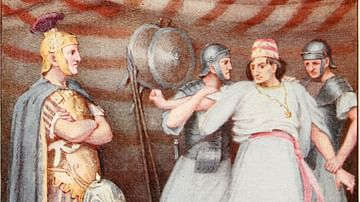
Jugurtha (r. 118-105 BCE) was King of Numidia in North Africa and grandson of the first Numidian king Masinissa (r. c. 202-148 BCE). He was the illegitimate son of Mastanabal, Masinissa's youngest son, and was the least likely of Masinissa's...

Definition
Tower of London
The Tower of London is a castle located in London alongside the River Thames which was first built by William the Conqueror from c. 1077 and significantly added to over the centuries. Often referred to in England as simply 'the...

Definition
Sundiata Keita
Sundiata Keita (aka Sunjaata or Sundjata, r. 1230-1255) was the founder of the Mali Empire (1240-1645) in West Africa. A prince of the Malinke tribe, Sundiata would not only overthrow the rule of the kingdom of Sosso (c. 1180-1235...
