
Search
Remove Ads
Advertisement
Search Results
Definition
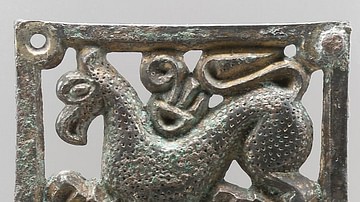
Bayan I
Bayan I (reigned 562/565-602 CE) was a king of the Avars, a confederation of heterogeneous people who migrated from the region of Mongolia, north of China, in 552 CE and came in contact with the Eastern Roman Empire c. 557 CE. Bayan...
Definition
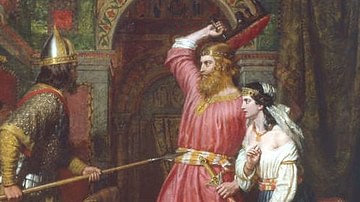
Alboin
Alboin (r. 560-572 CE) was a king of the Lombards who led his people into Italy and founded the Kingdom of the Lombards which lasted from 568-774 CE. His father was Audoin, King of the Lombards, and his mother Queen Rodelinda. He was...

Definition
Homolovi
Homolovi or Homolovi State Park (formerly: Homolovi Ruins State Park) is a cluster of archaeological sites that contains the ruins of eight pre-Columbian Ancestral Puebloan (Anasazi) and Hopi pueblos in addition to some 300 other remains...

Article
Effects of the Black Death on Europe
The outbreak of plague in Europe between 1347-1352 – known as the Black Death – completely changed the world of medieval Europe. Severe depopulation upset the socio-economic feudal system of the time but the experience...

Article
Origins of World Agriculture
Agriculture arose independently at several locations across the world, beginning about 12,000 years ago. The first crops and livestock were domesticated in six rather diffuse areas including the Near East, China, Southeast...

Article
Thanksgiving Day: A Brief History
The United States holiday of Thanksgiving is generally understood to be inspired by the harvest feast celebrated by the citizens of Plymouth Colony (later known as pilgrims) and the Native Americans of the Wampanoag...

Article
Scandinavia Before the Vikings
In the Merovingian period, Scandinavia was only just emerging from its prehistoric Iron Age. A process of political centralization that had begun in the Migration Period led to the emergence of the first Scandinavian...

Article
Roger Williams' The Bloody Tenent of Persecution
The Bloody Tenent of Persecution (original title, The Bloody Tenenent of Persecution for Cause of Conscience) is a 1644 CE book by the Puritan separatist Roger Williams (l. 1603-1683 CE) which is best...

Interview
Interview: Scotland & the Flemish People
The Flemish are among the most important and perhaps the most underappreciated immigrant groups to have shaped the history of medieval and early modern Scotland. They came to Scotland as soldiers and settlers...

Article
Winthrop & Williams: Religious Persecution & Freedom in New England
The Puritans who settled New England claimed they came to the New World for religious freedom but, once settled, made it clear that this freedom was for themselves only and dissent would...
