
Search
Remove Ads
Advertisement
Search Results

Definition
Homo Rudolfensis
Homo rudolfensis is an early human species that lived in East Africa between c. 2.5 and 1.8 million years ago. It is known from a handful of skull, jaw and teeth fragments that remind alternatingly of Homo or of Australopithecus...

Definition
Belgian Congo - One of Africa's Most Notorious Colonies
Belgian Congo was a colony of Belgium from 1908 until 1960. Prior to that, the region had been the Congo Free State (created in 1885), which was effectively a private enterprise of King Leopold II...

Definition
Hellenistic Astrology
Hellenistic astrology encompassed various forms of divination in Greece and the Mediterranean, all linked to the observation of astronomical phenomena. Hellenistic astrology was based on the belief that the stars and planets...

Definition
Viking Raids on Paris
Throughout the 9th century CE, Viking raids on the region of Francia (roughly modern-day France) increased in frequency, destabilizing the region, and terrorizing the populace. The raids seem to have been inspired by the death...
Definition
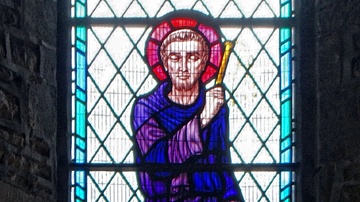
Guthlac of Crowland
Guthlac of Crowland (c. 674 - 11 April 714 CE) was an Anglo-Saxon saint from the Kingdom of Mercia. He is best known for his years spent as a hermit in the Fens region of the East Midlands. Guthlac was born into a noble Mercian...
Definition
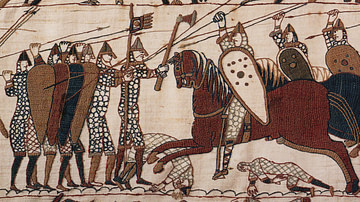
Battle of Hastings
The Battle of Hastings in south-east England on 14 October 1066 saw the defeat of the Anglo-Saxon king Harold II (r. Jan-Oct 1066) by the invading Norman army led by William, Duke of Normandy (reigned from 1035). After a day...

Definition
Charles the Simple
Charles the Simple (Charles III of France, l. 879-929, r. 893-923) was king of West Francia (roughly modern-day France) toward the end of the period of Viking raids in the region. His epithet `the simple' refers to his habit...

Definition
Saint Boniface
Saint Boniface (born as Wynfreth, l. 672-754) is one of the most famous saints in the Netherlands. He helped Pope Gregory II (r. 715-731), who was keen to convert pagan Germanic tribes, to achieve his goal, the Christianization...

Article
Battle of Buxar
The Battle of Buxar (aka Bhaksar or Baksar) in Bihar, northeast India, on 22-23 October 1764 saw a British East India Company (EIC) army led by Hector Munro (1726-1805) gain victory against the combined forces of the Nawab of...

Article
The Extent of the Roman Empire
Time has seen the rise and fall of a number of great empires - the Babylonian, the Assyrian, the Egyptian, and lastly, the Persian. Regardless of the size or skill of their army or the capabilities of their leaders...
