
Search
Search Results

Image
Mesopotamian Male Worshiper Votive Figure
Mesopotamian male worshiper votive figure, from Eshnunna, Mesopotamia (modern-day Tell Asmar), 2750-2600 BCE.
Metropolitan Museum of Art, New York.

Definition
Tiamat
Tiamat is the Mesopotamian goddess associated with primordial chaos and the salt sea best known from the Babylonian epic Enuma Elish. In all versions of the myth, following the original, Tiamat always symbolizes the forces of chaos, which...

Article
Ancient Egyptian Science & Technology
The great temples and monuments of ancient Egypt continue to fascinate and amaze people in the modern day. The sheer size and scope of structures like the Great Pyramid at Giza or the Temple of Amun at Karnak or the Colossi of Memnon are...

Article
The Legend of Cutha - A How-To on the Proper Relationship with One's God
The Legend of Cutha (also known as the Cuthean Legend of Naram-Sin, Cutha Legend, and Kutha Legend) is a fictional work dated to the 17th century BCE belonging to the genre known as Mesopotamian naru literature. It features the Akkadian king...
Article
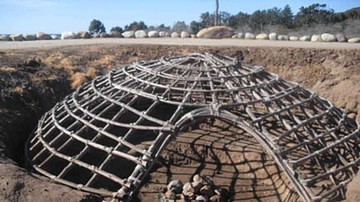
Origin of the Sweat Lodge
The sweat lodge is a temporary or permanent structure integral to Native American culture and frequently used in spiritual ceremonies. The lodge is often a low, dome-shaped, structure heated by hot rocks which produce steam as water is poured...

Article
Sioux Ceremonial Pipe
The Sioux ceremonial pipe is a sacred object of the Sioux nation used in the seven sacred rites as well as other observances to connect the people with the Great Spirit (Wakan Tanka), Mother Earth, the spirit world, and each other. Pipe rituals...

Article
Indigenous Intercultural Health in Chile
Since the return to democracy in Chile in 1990 CE, the new governments have dealt with one of the great historical debts of the Chilean state, its relationship with the indigenous peoples. These peoples have been historically marginalized...

Article
Daily Life in Ancient Mesopotamia - Mirroring the Modern World
Daily life in ancient Mesopotamia cannot be described in the same way one would describe life in ancient Rome or Greece. Mesopotamia was never a single, unified civilization, not even under the Akkadian Empire of Sargon of Akkad (the Great...

Definition
Ancient Syria
Syria is a country located in the Middle East on the shore of the Mediterranean Sea and bordered, from the north down to the west, by Turkey, Iraq, Jordan, Israel, and Lebanon. It is one of the oldest inhabited regions in the world with archaeological...

Image
Mesopotamian Beer Rations Tablet
The temples issued workers with daily rations of barley beer, the staple drink of Mesopotamia. The tablet was impressed with five different types of numerical symbol. From Mesopotamia, Iraq. Late Uruk Period, 3100-3000 BCE. (The British Museum...
