
Search
Remove Ads
Advertisement
Search Results

Article
Family Planning in Greco-Roman Antiquity
Family planning was a topic of vital importance in the ancient Mediterranean. Some of the earliest medical literature from ancient Greece and Rome deals with fertility and reproductive health. Among the numerous treatments and procedures...

Article
Ten Ancient Mesopotamia Facts You Need to Know - Fun Facts on the Cradle of Civilization
Mesopotamia is the ancient Greek name (meaning "the land between two rivers," the Tigris and Euphrates) for the region corresponding to modern-day Iraq and parts of Iran, Syria, and Turkey. It is considered the "cradle of civilization" for...

Definition
Religion in the Ancient World - Order and the Spiritual Experience
Religion (from the Latin Religio, meaning "restraint," or Relegere, according to Cicero, meaning "to repeat, to read again," or, most likely, Religionem, "to show respect for what is sacred") is an organized system of beliefs and practices...

Definition
Ishtar
Ishtar (Inanna in Sumerian sources) is a primary Mesopotamian goddess closely associated with love and war. This powerful Mesopotamian goddess is the first known deity for which we have written evidence. While largely unknown in the modern...

Definition
Mesopotamia - The Beginning of Beginnings
Mesopotamia (from the Greek, meaning "between two rivers") was an ancient region located in the Near East (Middle East) bounded in the northeast by the Zagros Mountains and in the southeast by the Arabian Plateau, corresponding to modern-day...

Definition
Near East - A Modern Term for an Ancient Land
The 'Near East' is a modern-age term for the region formerly known as the 'Middle East,' comprising Armenia, Cyprus, Egypt, Iraq, Iran, Israel, Jordan, Lebanon, Palestine, Syria, and part of Turkey, corresponding to ancient Urartu, Mesopotamia...
Collection
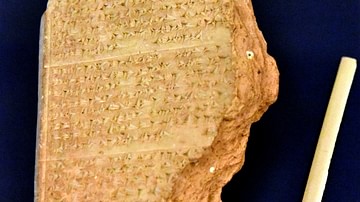
Twelve Stories from the Mesopotamian Scribal School
Sumerian schools (known as edubba, “House of Tablets”) trained the scribes of ancient Mesopotamia in reading, writing, interpretation of texts, general knowledge, and the specifics of whatever field they would eventually work in. The Sumerian...
Image
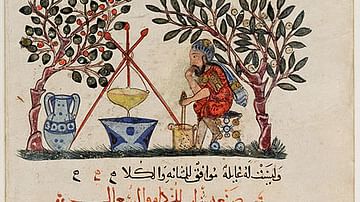
Ancient Mesopotamian Pharmacist Prepares Elixir
An Arab folio on which is depicted a pharmacist preparing an elixir. From the manuscript of the De Materia Medica by Dioscorides, 1st century CE. Metropolitan Museum of Art, New York

Article
The Early History of Clove, Nutmeg, & Mace
The spices clove, nutmeg, and mace originated on only a handful of tiny islands in the Indonesian archipelago but came to have a dramatic, far-reaching impact on world trade. In antiquity, they became popular in the medicines of India and...
Image
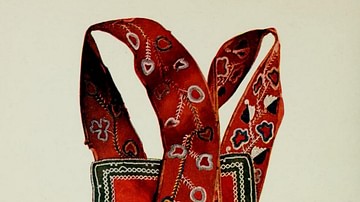
Native American Medicine Bag
Native American medicine bag, illustration from the Annual Archaeological Report, 1915, by Rowland B. Orr, published in Ontario Sessional Papers, 1916, No. 17-18, 1916.
