
Search
Remove Ads
Advertisement
Search Results

Article
On the Pallava Trail in Kanchipuram
The Pallavas ruled south-eastern India from the 3rd through the 9th centuries CE. Their empire covered what is today the Tamil Nadu state. Their origin is shrouded in mystery though historians believe their roots...

Article
Slavery in Plantation Agriculture
The first plantations in the Americas of sugar cane, cocoa, tobacco, and cotton were maintained and harvested by African slaves controlled by European masters. When African slavery was largely abolished in the mid-1800s...

Interview
Weavers, Scribes, and Kings: A New History of the Ancient Near East with Amanda H. Podany
In this interview, World History Encyclopedia sits down with author and Assyriologist Amanda H. Podany to learn all about her new book Weavers, Scribes, and Kings: A New...

Article
Religious Developments in Ancient India
For well over 1,000 years, sacred stories and heroic epics have made up the mythology of Hinduism. Nothing in these complex yet colourful legends is fixed and firm. Pulsing with creation, destruction, love...
Image
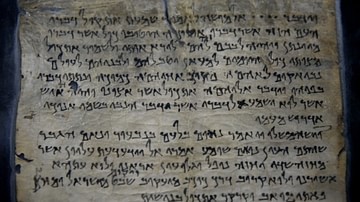
Dead Sea Scroll Testimonia from Qumran
Dead Sea Scroll number 175 (4Q175), which was found in Cave 4 at Qumran (Khirbet Qumran or Wadi Qumran), West Bank of the Jordan River, near the north part of the Dead Sea, modern-day State of Israel. It is also...

Image
Mummy Mask of Pasyg
Cartonnage, painted, and gilded mummy mask of Pasyg (or Pa-remet-syg; Greek, Promsiko). The mask of Pa-remet-syg is the only one from Meir which mentions the name of the deceased, on the back, in a demotic script. It also mentions...

Video
The Rosetta Stone: What is it and Why is it so Important?
The discovery of the Rosetta Stone unlocked the secrets of Ancient Egypt with the Ancient Greek and Demotic texts being the key to translating the Hieroglyphics for the first time. So, if you want...

Image Gallery
A Gallery of the Indus Valley Civilization
The Indus Valley Civilization (c. 7000-c. 600 BCE) is among the oldest in the world but, as it was only “discovered” in 1829 – after ancient Egyptian and Mesopotamian sites had already been excavated – many...
Image
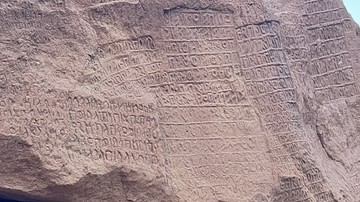
Inscriptions at Jabal Ikmah
Jabal Ikmah, often referred to as an ‘open-air library’, contains hundreds of inscriptions engraved and carved in relief on the rock faces and boulders of a gorge, not far from Dadan, the seat of the Dadanite and Lihhyanite...
Image
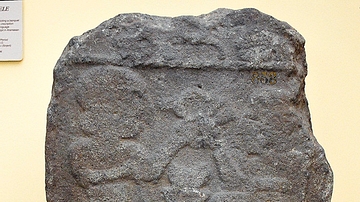
Stela from Ördek-Burnu
The inscriptions on this basalt stela, which depicts a banquet scene, were Hittite hieroglyphic but the script itself was Aramaean. From Ördek-Burnu (modern-day Sinjerli, Gaziantep, Turkey). Late Hittite period, 9th century...
