
Search
Remove Ads
Advertisement
Search Results

Article
The Spice Trade & the Age of Exploration
One of the major motivating factors in the European Age of Exploration was the search for direct access to the highly lucrative Eastern spice trade. In the 15th century, spices came to Europe via the Middle...

Definition
King Arthur
King Arthur is among the most famous literary characters of all time. The Arthurian legend of the Knights of the Round Table, Camelot, the Quest for the Holy Grail, the love affair of Lancelot and Guinevere, and the wizard Merlin...

Definition
Charvaka - The Ancient Indian Philosophy of Hedonism
Charvaka (also given as Carvaka) was a philosophical school of thought developed in ancient India circa 600 BCE, stressing materialism as the means by which one understands life and lives in the world...

Definition
Indo-European Languages
The Indo-European languages are a family of related languages that today are widely spoken in the Americas, Europe, and also Western and Southern Asia. Just as languages such as Spanish, French, Portuguese and Italian are...

Article
Boethius: First of the Medievals?
Anicius Manlius Severinus Boethius (c. 477-524/525) was a scholar in Late Antiquity who was imprisoned and executed by Theodoric (r. 493-526 CE) but was later idolised by medieval intellectuals. His most famous work...
Article
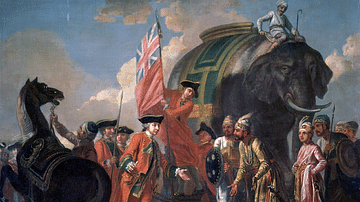
Battle of Plassey
The Battle of Plassey on 23 June 1757 saw Robert Clive's East India Company army defeat a larger force of the Nawab of Bengal. Victory brought the Company new wealth and marked the beginning of its territorial expansion in the...

Image
Post Kushan India
A map showing the political situation in the Indian Subcontinent following the fall of the Kushan Empire

Definition
Buddhism
Buddhism is a non-theistic religion (no belief in a creator god), also considered a philosophy and a moral discipline, originating in the region of modern-day India in the 6th and 5th centuries BCE. It was founded by the sage Siddhartha...

Interview
Interview: Buddhism in Korea
In this interview, James Blake Wiener, Co-Founder and Communications Director at Ancient History Encyclopedia (AHE), speaks to Emeritus Professor James H. Grayson, Professor of Korean Studies at the University of Sheffield...

Definition
Intolerable Acts
The Intolerable Acts, also known as the Coercive Acts, were five laws passed by the Parliament of Great Britain in 1774 to punish the Thirteen Colonies of British North America for the Boston Tea Party. Though the acts primarily...
