
Search
Did you mean: Empire?
Remove Ads
Advertisement
Search Results

Article
Sioux Story of The Gift of Corn
Corn (maize) was central to the lives of Native Americans across North, Central, and South America. Maize was introduced to North America from Mesoamerica c. 700/900 CE and transformed the lives of the indigenous peoples...

Definition
First Agricultural Revolution
The First Agricultural Revolution, beginning c. 12-20,000 years ago, was characterized by the emergence of different agricultural systems in different parts of the world, whose common trait was the use of native species...

Article
Hernando de Soto's Expedition to La Florida (1539-1542)
The Spanish explorer Hernando de Soto (c. 1500-1542) landed on the west coast of Florida on 30 May 1539, hoping to find wealthy kingdoms to conquer and plunder. His crew journeyed for over four...

Article
Jade in Mesoamerica
Jade was a highly-esteemed material in many Mesoamerican cultures, making it a valued regional trade good and first choice for objects of religious and artistic value such as masks, ceremonial axeheads, figurines, and jewellery...

Interview
Interview: Preclassic Maya
The genesis of Maya civilization in Mesoamerica was marked by an effervescence in the arts, the beginnings of their written language with glyphs, and a great attention to detail in the sphere of urban planning. Yet, despite...

Definition
Inca Art
The art of the Inca civilization of Peru (c. 1425-1532 CE) produced some of the finest works ever crafted in the ancient Americas. Inca art is best seen in highly polished metalwork, ceramics, and, above all, textiles, which was considered...

Definition
K'inich Janaab' Pakal
K'inich Janaab' Pakal (23 March 603 CE - 31 March 683 CE) was the Maya king of Palenque in the modern-day State of Chiapas, Mexico. Also known as Pacal (which means 'shield') and Pacal the Great, he is most famous for raising...

Definition
Xibalba
Xibalba (Shee-bal-ba) was the name the K'iche Maya gave to the underworld. For the Yucatec Maya the underworld was known as Metnal. The name Xibalba translates as 'Place of Fright', which indicates the terror the place had in the Maya...

Article
Dynamics of the Neolithic Revolution
The Neolithic Revolution began between 10,000 and 12,000 years ago at several widely dispersed locations across the world, when our ancestors first began planting and raising crops. Agricultural communities sprang...
Article
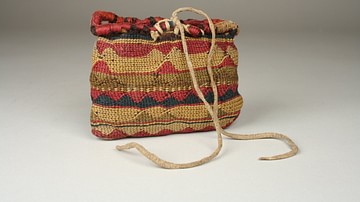
Making the Sacred Bundle
Making the Sacred Bundle is an origin story of the medicine bag from the Pawnee nation. A medicine bag is a pouch or bundle containing items of resonant spiritual power for an individual or the tribal community that symbolize...
