
Search
Remove Ads
Advertisement
Search Results

Definition
James A. Garfield - The Unlikely Rise and Tragic Assassination of a President
James A. Garfield (1831-1881) was an American politician from Ohio who served as the 20th president of the United States from 4 March 1881 until his death the following 19 September...

Definition
The Ancient City
In the study of the ancient world a City is generally defined as a large populated urban center of commerce and administration with a system of laws and, usually, regulated means of sanitation. This is only one definition, however...

Definition
Gnosticism
Gnosticism is the belief that human beings contain a piece of God (the highest good or a divine spark) within themselves, which has fallen from the immaterial world into the bodies of humans. All physical matter is subject to decay...
Definition
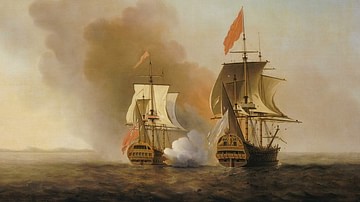
Galleon
The galleon (Spanish: galeón, French: galion) was a type of sailing ship used for both cargo carrying and as a warship. Galleons dominated the seas in the second half of the 16th century, and with their lower superstructures, they were...

Definition
Gold in Antiquity
Gold, chemical symbol Au (from the Latin aurum meaning 'shining dawn'), is a precious metal which has been used since antiquity in the production of jewellery, coinage, sculpture, vessels and as a decoration for buildings, monuments...

Definition
Alexander Hamilton
Alexander Hamilton (1755/57-1804) was a lawyer and politician, often recognized as a Founding Father of the United States. He served as George Washington's aide-de-camp during the American Revolution, before going on to become...
Definition
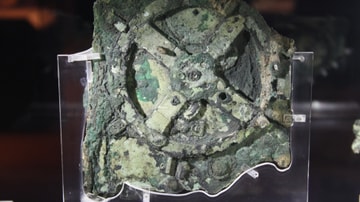
Science
The term science comes from the Latin word scientia, meaning "knowledge". It can be defined as a systematic attempt to discover, by means of observation and reasoning, particular facts about the world, and to establish laws connecting...

Definition
Carthago Nova
Carthago Nova (modern-day Cartagena) was a city on the southern Iberian Peninsula, Spain, originally known as Mastia. Human habitation of the region predates the Neolithic Period, but the area around the site of Carthago Nova seems...

Definition
Charles V, Holy Roman Emperor
Charles V, Holy Roman Emperor (24 February 1500 to 21 September 1558) reigned from 1519 until his abdication in 1556 and was one of the most powerful rulers in the history of the Habsburg dynasty. Through a series of...

Article
The Printing Revolution in Renaissance Europe
The arrival in Europe of the printing press with moveable metal type in the 1450s CE was an event which had enormous and long-lasting consequences. The German printer Johannes Gutenberg (c. 1398-1468 CE...
