
Search
Remove Ads
Advertisement
Search Results

Definition
Johannes Gutenberg
Johannes Gutenberg (l. c. 1398-1468) was the inventor of the printing press (c. 1450) who seems to have developed the device from wine and oil presses of the time. Gutenberg’s printing press not only revolutionized book making...

Definition
Saint Cyril
Saint Cyril (aka Kyrillos and Constantine the Philosopher, d. 867 CE) was a Byzantine linguist, teacher, scholar and missionary who famously preached Christianity to the Slavs in Moravia with his brother Methodius during the 9th century...

Definition
Edward VI of England
Edward VI of England reigned as king from 1547 to 1553 CE. Succeeding his father Henry VIII of England (r. 1509-1547 CE), Edward was only nine years old at the time and so the kingdom was ruled by a council of nobles, foremost...

Definition
Mauretania
Mauretania was an ancient kingdom in northwest Africa, encompassing regions of modern-day Morocco and Algeria. Although it shares a name with the modern country of Mauritania, they do not overlap. Ancient Mauretania was named after...

Definition
Saladin
Saladin (1137-93) was the Muslim Sultan of Egypt and Syria (r. 1174-1193) who shocked the western world by defeating an army of the Christian Crusader states at the Battle of Hattin and then capturing Jerusalem in 1187. Saladin all but...

Definition
Counter-Reformation - The Catholic Establishment of Ultimate Truth
The Counter-Reformation (also known as the Catholic Reformation, 1545 to c. 1700) was the Catholic Church's response to the Protestant Reformation (1517-1648). It is usually dated from the...

Definition
Leon Battista Alberti
Leon Battista Alberti (1404-1472 CE) was an Italian scholar, architect, mathematician, and advocate of Renaissance humanism. Alberti famously wrote the treatise On Architecture where he outlines the key elements of classical...

Definition
Paestum
Paestum, also known by its original Greek name as Poseidonia, was a Greek colony founded on the west coast of Italy, some 80 km south of modern-day Naples. Prospering as a trade centre it was conquered first by the Lucanians and then...
Definition
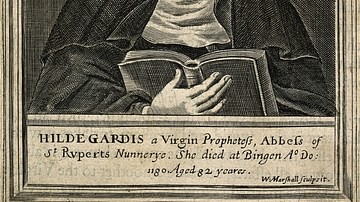
Hildegard of Bingen
Hildegard of Bingen (also known as Hildegarde von Bingen, l. 1098-1179) was a Christian mystic, Benedictine abbess, and polymath proficient in philosophy, musical composition, herbology, medieval literature, cosmology, medicine...

Definition
The Medieval Church
Religious practice in medieval Europe (c. 476-1500) was dominated and informed by the Catholic Church. The majority of the population was Christian, and "Christian" at this time meant "Catholic" as there was initially no other...
