
Search
Did you mean: Roman Mythology?
Remove Ads
Advertisement
Search Results
Image
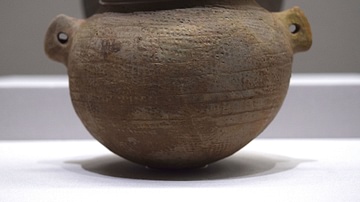
Ancient Korean or Japanese Jar
This jar was excavated from a box-style stone coffin in Daishogunyama Tumulus on Tsushima, the Japanese island closest to the Korean peninsula. Its round body was created by lightly beating the outer surface of the...

Article
A Visual Who's Who of Greek Mythology
Achilles The hero of the Trojan War, leader of the Myrmidons, slayer of Hector and Greece's greatest warrior, who sadly came unstuck when Paris sent a flying arrow guided by Apollo, which caught him in his...

Article
Elves & Dwarves in Norse Mythology
Elves and dwarves represent minor divine figures in Norse mythology. Elves (álfar) and dwarves (dvergar) have in common their talent for creating precious objects, skill, agility, and moral ambiguity. Dwarves appear...

Definition
Three Kingdoms Period in Korea
The Three Kingdoms Period of ancient Korea (57 BCE – 668 CE) is so-called because it was dominated by the three kingdoms of Baekje (Paekche), Goguryeo (Koguryo), and Silla. There was also, though, a fourth entity...

Definition
Unified Silla Kingdom
The Unified Silla Kingdom (668- 935 CE) was the first dynasty to rule over the whole of the Korean peninsula. After centuries of battles with the other states of the Three Kingdoms Period (57 BCE - 668 CE) Silla benefitted...

Article
The Bronze Bells of Ancient Korea
The metalworkers of ancient Korea were highly skilled artists and some of their finest surviving works are the large bronze bells cast for use in Buddhist temples and monasteries. Both the Unified Silla kingdom and...

Article
Silla Pottery
The pottery of ancient Korea stretches back to prehistory when simple brown wares were made and decorated with geometrical incisions and ends with the production of the superb celadons and white porcelain of the Goryeo dynasty but...
Image
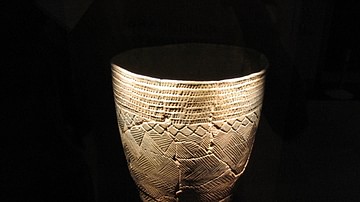
Korean Neolithic Pot
A typical pottery bowl from the Korean Neolithic period with pointed base and simple incised decoration. (National Museum of Korea, Seoul, South Korea)
Image
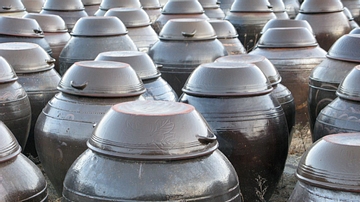
Korean Onggi Jars
Korean onggi lidded-jars, made since ancient times they are used for a multitude of purposes and carry simple decoration.

Article
Dolmens of Ancient Korea
Dolmens (in Korean: koindol or chisongmyo) are simple structures made of monolithic stones erected during the late Neolithic period or Korean Bronze Age (1st millennium BCE). In ancient Korea they appear most often near...
