
Search
Remove Ads
Advertisement
Search Results
Image
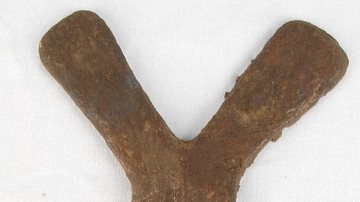
Copper Curency Ingot, Luba Kingdom
A copper cross used as a currency by such central African states as the Kingdom of Luba (15-19th century CE). Height: 19.5 cm. (British Museum, London)
Image
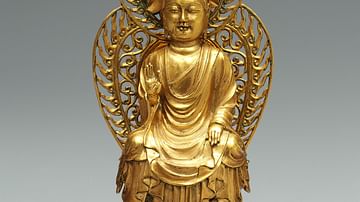
Unified Silla Kingdom Gold Buddha
A gold Buddha statuette from the Unified Silla Kingdom (668-918 CE), Korea. From a stone pagoda at the Hwangbok-sa temple site, Gyeongju before 706 CE. Height 12.5 cm (National Museum of Korea, Seoul, South Korea)

Image
Horned Mask, Luba Kingdom
A wooden horned mask of the Kingdom of Luba (15-19th century CE), central Africa. Height: 47 cm. (British Museum, London)

Image
Buddhist Stele, Unified Silla Kingdom
A soapstone Buddhist stele from the Unified Silla Kingdom of Korea. From the Piamsa Temple. The scene depicts Buddha and disciples with apsaras looking on. Height: 40 cm, c. 673 CE. (National Museum of Korea...
Image
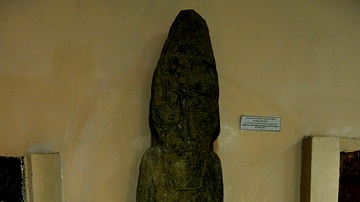
A Sandstone Statue from the Musasir Kingdom
This is one of the very few surviving artifacts from the Musasir Kingdom, 8th century BCE. It was found near Rowanduz village, modern Sulaimaniya Governorate, Iraq. The statue has lost most of its fine details...

Image
Isambard Kingdom Brunel
An 1857 photograph by Robert Howlett of the engineer Isambard Kingdom Brunel (1806-1859), one of the key figures of the Industrial Revolution in Britain. Brunel is standing in front of the restraining chains used in the...

Image
Funerary Urn, Unified Silla Kingdom
A ceramic funerary urn from the Unified Silla kingdom of ancient Korea. The decoration is typical of the period and was achieved using stamps. 8th century CE. (Freer and Sackler Galleries, Washington, D.C)
Image
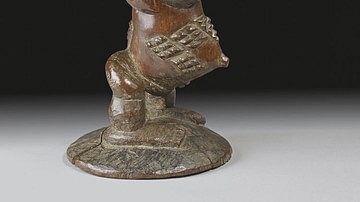
Carved Stool, Luba Kingdom
A carved wooden stool in the form of a figure from the Kingdom of Luba (15-19th century CE), central Africa. Height: 42.5 cm. (British Museum, London)

Article
Interrelations of Kerma and Pharaonic Egypt
The vacillating nature of Ancient Egypt's associations with the Kingdom of Kerma may be described as one of expansion and contraction; a virtual tug-of-war between rival cultures. Structural changes in Egypt's...

Definition
The Hittites
The Hittites occupied the ancient region of Anatolia (also known as Asia Minor, modern-day Turkey) prior to 1700 BCE, developed a culture apparently from the indigenous Hatti (and possibly the Hurrian) people, and expanded their...
