
Search
Remove Ads
Advertisement
Search Results

Definition
Dodona
Dodona in Epirus, north-west Greece, lies in a valley on the eastern slopes of Mt. Tomaros and was famed throughout the ancient Greek world as the site of a great oracle of Zeus. The site was expanded in the Hellenistic period, and one...

Definition
Childeric I
Childeric I (r. c. 458-481) was a late antiquity king of the Salian Franks during the period of the fall of the Western Roman Empire. Childeric's reign solidified the Salians as a dominant Frankish tribe and helped pave the way for...
Definition
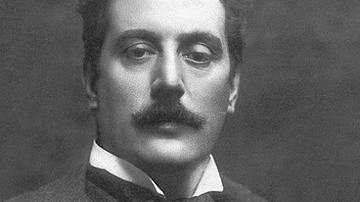
Giacomo Puccini
Giacomo Puccini (1858-1924) was an Italian composer best known for his operas La Bohème, Tosca, Madama Butterfly, and Turandot. Puccini drew inspiration from a wide range of literary sources, and his late Romantic music with its...
Definition
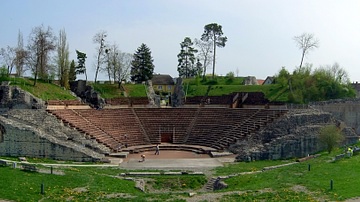
Augusta Raurica
Augusta Raurica is a former Roman colony and city located on the Rhine River some 11 km (7 miles) east of the modern Swiss city of Basel, in between the towns of Kaiseraugst and Augst. Founded by Lucius Munatius Plancus (90 BCE...

Image
Map of the Year of the Four Emperors, 69 CE
The Year of the Four Emperors (69 CE) was a moment of deep instability in the Roman Empire, marked by the rapid succession of Galba (June 68–January 69 CE), Otho (January–April 69 CE), Vitellius (April–December...
Image
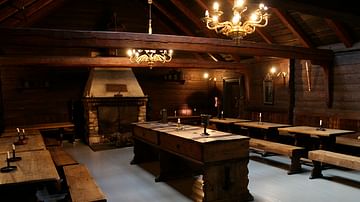
Jakobsfjorden and Bellgården's Schøtstue, Bergen
The "schøtstue" was a traditional building and assembly room of the Hanseatic merchants in Bergen during the Middle Ages. The picture is of the Jakobsfjorden and Bellgården's Schøtstue, which is part...

Article
Letters & Post in the Ancient World
Letters and their delivery via a state communication system was a feature of many ancient cultures. The writing medium may have differed but the Mesopotamians, Egyptians, Greeks, Romans, and Incas all had the means...

Article
Reforms of Augustus
Emperor Augustus (27 BCE – 14 CE) accomplished much during his time on the Roman throne, far more than many of his successors. According to historian Mary Beard in her book SPQR, he transformed the structures of Roman Empire...
Article
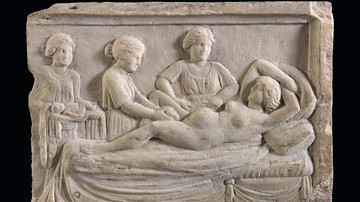
Childbirth in Ancient Rome
Childbirth in ancient Rome was considered the main purpose of marriage. Roman girls married in their early teens, and in elite society, some married before they reached puberty. The legal age for marriage was 12 for a...
Article
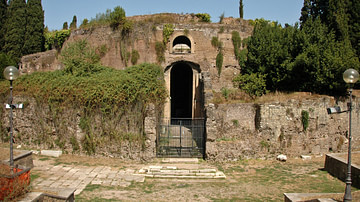
Mausoleum of Augustus
The Mausoleum of Augustus was actually one of the first of many large building projects undertaken in the reign of Rome's first emperor. When the Mausoleum was completed in 28 BCE, it was easily the biggest tomb in the Roman...
