
Search
Remove Ads
Advertisement
Search Results

Article
Rome under the Julio-Claudian Dynasty
The Julio-Claudians were the first dynasty to rule the Roman Empire. After the death of the dictator-for-life Julius Caesar in 44 BCE, his adopted son Octavian - later to become known as Augustus (r. 27 BCE -...

Article
Astronomy in the Scientific Revolution
The astronomers of the Scientific Revolution rejected long-held theories of ancient thinkers like Claudius Ptolemy and Aristotle and instead set out to systematically observe the heavens in order to create a...
Article
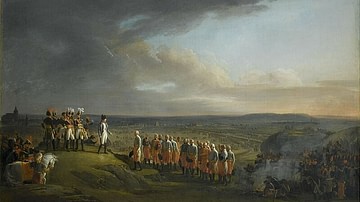
Ulm Campaign
The Ulm Campaign (25 September to 20 October 1805) was a military operation during the War of the Third Coalition (1805-1806). Through a series of maneuvers, the 210,000 men of the French Grande Armée, led by Emperor Napoleon I...
Article
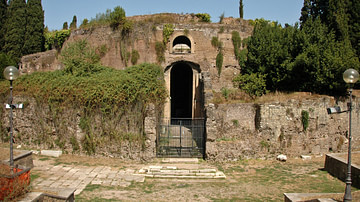
Mausoleum of Augustus
The Mausoleum of Augustus was actually one of the first of many large building projects undertaken in the reign of Rome's first emperor. When the Mausoleum was completed in 28 BCE, it was easily the biggest tomb in the Roman...

Article
Sassanian Kings List & Commentary
The Sassanian Empire (224-651) was the greatest expression of Persian culture in the ancient world. It was consciously modeled on the earlier Achaemenid Empire (c. 550-330 BCE) which established Persian supremacy...
Interview
Interview: Barry Strauss on Ten Caesars
Dr. Barry Strauss' Ten Caesars: Roman Emperors from Augustus to Constantine tells the epic story of the Roman Empire from its rise to its eastern reinvention, from Augustus, who founded the empire, to Constantine...

Interview
Interview with Michael Levy
Join World History Encyclopedia as they talk to Michael Levy, a prolific composer of the ancient lyre all about his inspiration and knowledge of the instrument. If you want to hear Michael perform, be sure to check out...
Article
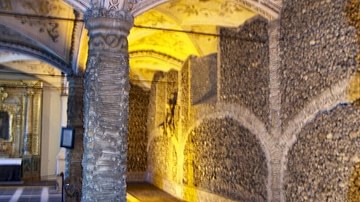
Skulls, Temples & Churches: A Visit to the Walled City of Evora
The sunbaked plain of the Alentejo region in central Portugal is called planicie dourada (golden plain) by the Portuguese, and it is dotted with cork oak forests, vineyards, olive groves...

Video
Mayflower Compact - PBS
The Pilgrims: AMERICAN EXPERIENCE - A brief explanation of the creation and significance of the Mayflower Compact.
Collection
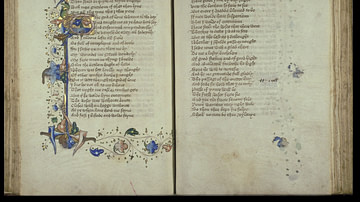
Medieval European Literature
Medieval literature developed in Europe from medieval folklore between c. 476 and c. 1500. The works ranged from poetry to drama, romance, prose, philosophical dialogues, and histories. Literary works were at first composed...
