
Search
Remove Ads
Advertisement
Search Results
Image
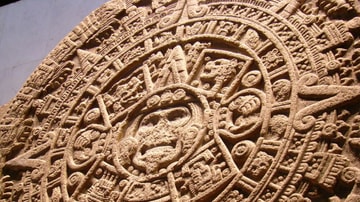
Tonatiuh, Calendar Stone
The Aztec Sun Stone (also known as the Calendar Stone) is a representation of the five eras of the sun from Aztec mythology. Some scholars consider the central face to be that of Tonatiuh, the sun god, while others maintain...

Image
French Republican Calendar
French Republican calendar for Year III (1794-95), drawing by Philibert Louis Debucourt.
Bibliothèque nationale de France.

Video
The Maya Calendar, Culture and History: an Introduction to a Mesoamerican Civilization
The Maya are a people indigenous to Mexico and Central America who have continuously inhabited the modern regions of Yucatan, Quintana Roo, Campeche, Tabasco, and Chiapas...
Image
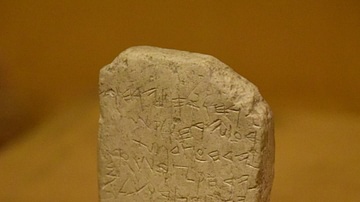
The Gezer Calendar
The Gezer calendar is regarded as the oldest Hebrew inscription as yet known. The inscription is scratched on a tablet of soft, chalky limestone and its lower part is broken and lost. The oblique fracture passes as square thought...

Video
Julian of Norwich: Her Secret Scribes
Julian of Norwich; her secret scribes. The unknown women who kept her book safe for centuries.

Video
Julian of Norwich
Short documentary on Julian of Norwich. Directed, Filmed and Edited by Britt Robinson.
Image
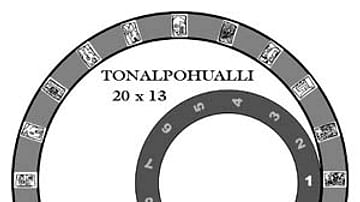
Tonalpohualli Mesoamerican Calendar
A representation of the Tonalpohualli – ‘Counting of the Days’ 260-day calendar used by ancient Mesoamerican cultures. Two systems ran simultaneously with a group of 13 numbered days combined with a group of 20...

Definition
Roman Empire
The Roman Empire, at its height (c. 117), was the most extensive political and social structure in western civilization. Building upon the foundation laid by the Roman Republic, the empire became the largest and most powerful political...

Video
The Sun Stone (The Calendar Stone), Aztec
The Sun Stone (or The Calendar Stone), Aztec, reign of Moctezuma II (1502-20), discovered in 1790 at the southeastern edge of the Plaza Mayor (Zocalo) in Mexico City, stone (unfinished), 358 cm diameter...

Video
Cradles of Civilization - The Lunar/Solar Calendar
The Babylonians developed a calendar based on the moon and sun cycles. The Lunar calendar was designed to work in conjunction with the solar cycle by adding leap months known an "intercalary" months.
