
Search
Remove Ads
Advertisement
Search Results

Image
Byzantine Mosaic of Children Seated on a Dromedary
Two children are seated on a dromedary. One of them wears a wreath around his head and is holding a bird in one hand and reins with the other hand. There is also a guide in front of them. Period: Early Byzantine, c. 6th century CE. Place...
Image
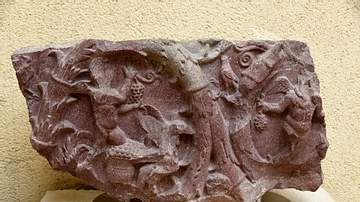
Fragment from an Imperial Sarcophagus
This porphyry fragment is thought to have belonged to the sarcophagus of the Byzantine Emperor Constantine the Great. 4th century CE. From Istanbul, in modern-day Turkey. (Museum of Archaeology, Istanbul, Turley).
Image
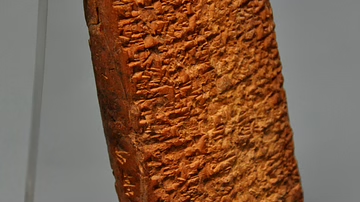
Ludingirra Letter
This terracotta cuneiform tablet is a letter from Ludingirra to his mother. Nippur (modern Nuffar, Al-Qadisiyah Governorate, Iraq), southern Mesopotamia. Old-Babylonian period, 1700 BCE. (Istanbul Archeological Museums/Ancient Orient Museum...
Image
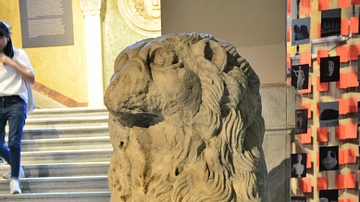
Lion Statue from the Bucaleon Palace
Lion statue from the Monumental Gate of Bucaleon Palace. Culture: Byzantine, Period: Early Byzantine, Findspot: Catladikapi, Istanbul, Materials: Marble. (Istanbul Archaeological Museum)
Image
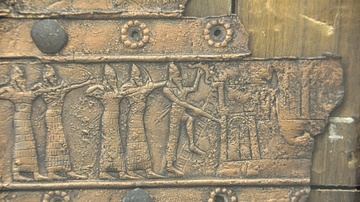
Siege Scene from Balawat Gate
Detail of the bronze casing of the Balawat gate. From Balawat (Imgur-Enlil), northern Mesopotamia, Iraq. Neo-Assyrian Period, reign of King Shalmaneser III, 858-824 BCE. (Ancient Orient Museum/Istanbul Archaeological Museums, Istanbul, Turkey...
Image
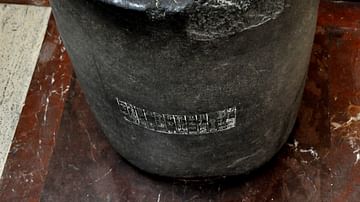
Diorite Mortar
This mortar was an offering from Gudea (ruler of Lagash) to the god Enlil. Neo-Sumerian era, 2141-2122 BCE. From Nippur (modern Nuffar, Al-Qadisiyah Governorate, Iraq), southern Mesopotamia.(Istanbul Archaeological Museums/Ancient Orient...
Image
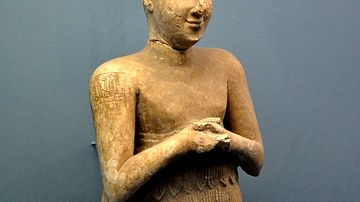
Statue of Lugal-Dalu
Lugal-Dalu was probably a local ruler of Adab. The inscriptions on the statue's right shoulder describe the depicted man as "king of Adab" and the statue as an offering to the temple of the god Esar (or E-Shar), the greatest god of the city...
Image
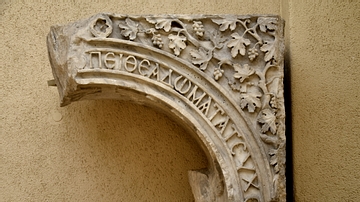
Fragment of a Byzantine Peacock Arch
This marble fragment of a Byzantine arch was part of an entablature. It came from the Saraçhane excavations and dates to 524-527 CE. The inner part of the arch of the architrave was decorated with a relief of a peacock. The surface was decorated...
Image
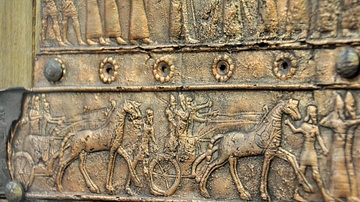
Battle Scene, Balawat Gate
Detail of the bronze casing of the Balawat gate showing war chariots. From Balawat (Imgur-Enlil), northern Mesopotamia, Iraq. Neo-Assyrian Period, reign of King Shalmaneser III, 858-824 BCE. (Ancient Orient Museum/Istanbul Archaeological...
Image
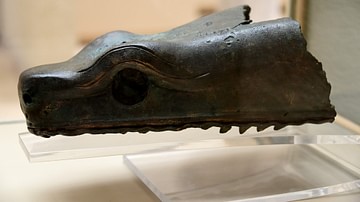
Head of a Serpent from the Serpent Column
This bronze serpent originally belonged to the "Serpent Column" at the Hippodrome of Constantinople, Sultanahmet, Istanbul, in modern-day Turkey. The column was erected to commemorate the Greeks who fought and defeated the Persian Empire...
