
Search
Remove Ads
Advertisement
Search Results

Image
Inanna Prefers the Farmer
This terracotta cuneiform tablet is about the myth of "Inanna prefers the farmer." In this myth, Enkimdu (the god of farming) and Dumuzi (the god of food and vegetation) tried to win the hand of the goddess Inanna. From Nippur (modern Nuffar...

Image
Man Feeding Mule, Byzantine Mosaic
A man is feeding his mule, Byzantine Mosaic, Period: Early Byzantine, circa: 6th century CE. Place: Constantinople, (Modern Istanbul, Turkey). Great Palace Mosaic Museum, Istanbul, Turkey. The Great Palace Mosaic Museum was inaugurated...

Image
Hittite Relief of Musicians
This basalt wall relief depicts four people playing on musical instruments. From Sam'al (modern-day Sinjerli, Gaziantep, Turkey). Late Hittite period, 8th century BCE. (Istanbul Archeological Museums/Ancient Orient Museum, Istanbul, Turkey...
Image
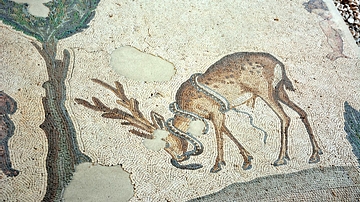
Stag & Snake, Byzantine Mosaic
The stag and the snake mosaic: In some ancient texts, the stag is seen as a rival to the snake. It can also draw a snake out of its hole with its breath. The deer was a symbol of fertility and the animal of Artemis. The stag is illustrated...
Image
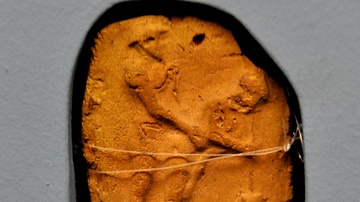
Erotic Terracotta Plaque
This terracotta plaque dates back to the old Babylonian period. It depicts a male and female having sex while the woman drinks a fluid (beer?) from a jar through a straw. Such scenes were mass-produced in southern Mesopotamia during the old...

Definition
John II Komnenos
John II Komnenos “the Handsome” was emperor of the Byzantine Empire from 1118 CE to 1143 CE. John, almost constantly on campaign throughout his reign, would continue the military successes of his father Alexios I with significant victories...

Image
Assyrian Amulet
This bronze plaque represents an amulet against bad spirits and diseases. From northern Mesopotamia (modern-day Iraq). Assyrian. Istanbul Archaeological Museums/Ancient Orient Museum, Istanbul, Turkey.
Image
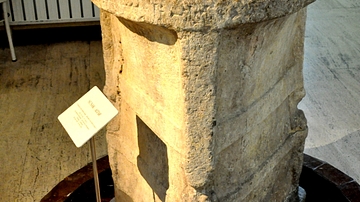
An Altar from Dur-Sharrukin
This limestone altar was dedicated to the temple of the god Sibitti by the Assyrian King Sargon II. From Dur-Sharrukin (modern Khorsabad, Ninawa Governorate, Iraq), Mesopotamia. Neo-Assyrian era, 721-705 BCE. (Istanbul Archeological Museums/Ancient...
Image
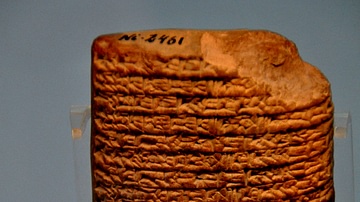
Love Poem Tablet from Nippur
A terracotta tablet with cuneiform inscriptions that narrates a love poem. This is the oldest love poem ever known. The poem was probably written by an unknown woman who was chosen as a bride for Shu-Sin, King of Ur, III dynasty. The poem...
Image
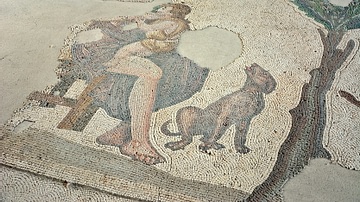
Mother & Dog, Byzantine Mosaic
Mother and the dog: A mother is breastfeeding her baby. The scene is a representation of Isis with her child Horus. A dog on the left of the woman is looking at her with its raised head. Period: Early Byzantine, circa 6th. century CE. Place...
