
Search
Remove Ads
Advertisement
Search Results

Definition
Hyksos - The Rulers of Foreign Lands Who Transformed Egypt
The Hyksos were a West Semitic-speaking people who gained a foothold in Egypt circa 1782 BCE at the city of Avaris in Lower Egypt, thus initiating the era known in Egyptian history as the Second...

Definition
Beowulf
Beowulf is an epic poem composed in Old English consisting of 3,182 lines. It is written in the alliterative verse style, which is common for Old English poetry as well as works written in languages such as Old High German, Old Saxon...

Definition
Mount Ararat
Mount Ararat (Armenian: Masis; Turkish: Ağrı Dağı; Kurdish: Çiyaye Agiri; Azeri: Ağrıdağ; Persian: Kūh-e Nūḥ) is a dormant, compound volcanic mountain, consisting of two ancient volcanic peaks, located in present-day eastern Turkey...

Definition
Hasdrubal Barca
Hasdrubal Barca (c. 244-207 BCE) was the younger brother of the Carthaginian general Hannibal (247-183 BCE) and commanded the forces of Carthage against Rome in Spain during the Second Punic War (218-202 BCE). They were both...

Definition
Armenian Mythology
The mythology of ancient Armenia is a rich blend of indigenous traditions with imported ideas from neighbouring cultures and migrating peoples added over the centuries. The legends and stories helped to explain natural phenomena...
Definition
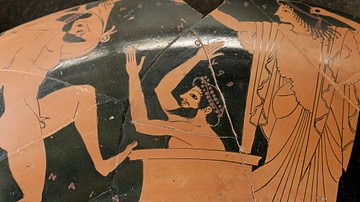
The Children of Heracles
The Children of Heracles (Heraclidae) is one of Euripides' lesser-known and least popular works, as is the myth surrounding the tragedy play. Its date is also uncertain, possibly written in the late 430s or early 420s BCE...

Definition
Hanseatic League
The Hanseatic League (also known as Hansa, Hanse, 1356-1862 CE) was a federation of north German towns and cities formed in the 12th century CE to facilitate trade and protect mutual interests. The league was centered in the German...

Definition
The Canterbury Tales
The Canterbury Tales (written c. 1388-1400 CE) is a medieval literary work by the poet Geoffrey Chaucer (l. c. 1343-1400 CE) comprised of 24 tales related to a number of literary genres and touching on subjects ranging from...

Definition
The Medieval Church
Religious practice in medieval Europe (c. 476-1500) was dominated and informed by the Catholic Church. The majority of the population was Christian, and "Christian" at this time meant "Catholic" as there was initially no other...
Definition
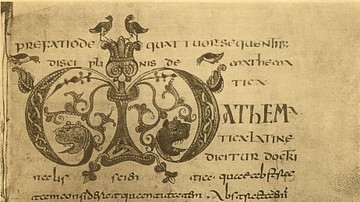
Etymologiae
The Etymologiae (Etymologies) is a Latin work by Isidore of Seville (l. c. 560 - 636 CE), compiled in the early 7th century CE and published in its final form shortly after his death. The book is a type of medieval encyclopedia and...
