
Search
Remove Ads
Advertisement
Search Results

Definition
Alphabet
The history of the alphabet started in ancient Egypt. By 2700 BCE Egyptian writing had a set of some 22 hieroglyphs to represent syllables that begin with a single consonant of their language, plus a vowel (or no vowel) to be supplied...
Definition
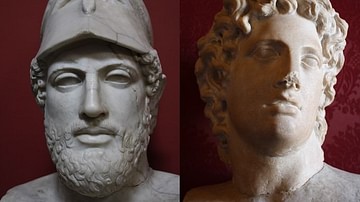
Plutarch
L. Mestrius Plutarchus, better known simply as Plutarch, was a Greek writer and philosopher who lived between c. 45-50 CE and c. 120-125 CE. A prodigious and hugely influential writer, he is now most famous for his biographical works...

Definition
Early Dynastic Period in Mesopotamia - Era of Many of the "Firsts" in Civilization
The Early Dynastic period in Mesopotamia is the modern-day archaeological term for the era in Mesopotamian history – circa 2900 to circa 2350/2334 BCE – during which some of...

Definition
Kukulcan - The Feathered-Serpent God of Mesoamerica
Kukulcan (pron. Koo-kool-kan) is the name of a feathered serpent god in the mythology and religion of Mesoamerica, in particular, the Yucatec Maya. He is also identified as the feathered serpent god...

Definition
Siddhartha Gautama
Siddhartha Gautama (better known as the Buddha, l. c. 563 - c. 483 BCE) was, according to legend, a Hindu prince who renounced his position and wealth to seek enlightenment as a spiritual ascetic, attained his goal and, in preaching...

Definition
Polis - The City-State of Ancient Greece
A polis (plural: poleis) was the typical structure of a community in the ancient Greek world. A polis consisted of an urban centre, often fortified and with a sacred centre built on a natural acropolis or harbour...

Definition
Norse Mythology
Norse mythology refers to the Scandinavian mythological framework that was upheld during and around the time of the Viking Age (c. 790- c. 1100 CE). Complete with a creation myth that has the first gods slaying a giant and turning...

Definition
Hellenistic Warfare
When Alexander the Great died in 323 BCE, he left behind an empire devoid of leadership. Without a named successor or heir, the old commanders simply divided the kingdom among themselves. For the next three decades, they fought...

Definition
Sargonid Dynasty
The Sargonid Dynasty was the last ruling house of the Neo-Assyrian Empire from 722-612 BCE, beginning with the reign of Sargon II and ending with fall of the Neo-Assyrian Empire. Some of the most famous kings in the history of...

Definition
Conquistador
The conquistadors, meaning "conquerors", were Iberian military adventurers who operated as the vanguard of empires in the 15th and 16th centuries by exploring areas of the world unknown to Europeans, defeating indigenous armies...
