
Search
Did you mean: Cimon?
Remove Ads
Advertisement
Search Results

Video
The Oldest Known Melody (Hurrian Hymn no.6 - c.1400 B.C.)
The Oldest known musical melody performed by the very talented Michael Levy on the Lyre. This ancient musical fragment dates back to 1400 B.C.E. and was discovered in the 1950's in Ugarit, Syria...

Video
The Hymn to Ninkasi (Sumerian Beer Recipe)
Being the first beer-brewers in history, beer had religious significance to the Sumerians, and was often brewed in temples by priestesses. Ninkasi was the tutelary goddess of beer in ancient Sumer. The...

Video
The Oldest Religious Text | Kesh Temple Hymn | Primary Source Immersive Reading
Transcript was put into the Closed Captions so turn it on and read along! The Kesh Temple Hymn is tied with the Instructions of Shuruppak, as the oldest surviving writing...

Article
Mesopotamian Education - Creating the First Written Works in History
Mesopotamian education was invented by the Sumerians following the creation of writing circa 3600/3500 BCE. The earliest schools were attached to temples, but later schools were established...

Article
Chola Art & Architecture
Like many great civilisations, the origins of the Chola, a Tamil Hindu dynasty in southern India, are shrouded in the temporal mists of uncertainty and obscurity. It is however known that they were influential from at least...

Definition
Horae
The Horae (Horai, sing. Hora) were the personification and goddesses of the seasons and the hours and, later on, were regarded as goddesses of order and justice in Greek mythology. They were the daughters of Zeus and the Titaness Themis...

Definition
Nisaba - Sumerian Goddess of Writing and Scribe of the Gods
Nisaba (also Naga, Se-Naga, Nissaba, Nidaba, and associated with Nanibgal) is the Sumerian goddess of writing, accounts, and scribe of the gods. Although her name is commonly given as Nidaba...

Article
Enlil in the E-kur - Praising God in Ancient Mesopotamia
Enlil in the E-Kur (circa 2000 BCE) is a Sumerian hymn praising the sky god Enlil, his temple/ziggurat at Nippur, and his consort Ninlil, depicting all three in glowing terms and Enlil as a creator...
Definition
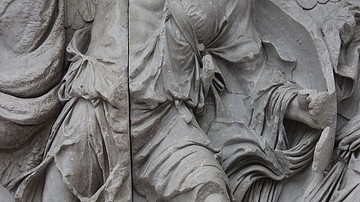
Uranus
Uranus (also spelt Ouranos) is the personification of heaven and the sky in Greek mythology. His Roman counterpart is Caelus. Gaia (Earth) gave birth to Uranus and chose him to be her equal. She lay with him, resulting in the birth of...

Definition
Mesopotamian Literature - The Earliest Works of the Imagination
Ancient Mesopotamian literature developed circa 2600 BCE after scribes, who had formerly been record-keepers, began composing original works in the region of Sumer. The Sumerians invented writing...
