
Search
Remove Ads
Advertisement
Search Results

Definition
Zhou Dynasty
The Zhou Dynasty (1046-256 BCE) was among the most culturally significant of the early Chinese dynasties and the longest lasting of any in China's history, divided into two periods: Western Zhou (1046-771 BCE) and Eastern Zhou (771-256...

Definition
Ancient India
India is a country in South Asia whose name comes from the Indus River. The name 'Bharata' is used as a designation for the country in their constitution referencing the ancient mythological emperor, Bharata, whose story is told...

Definition
Celtic Warfare
The Celts were a linguistic group which spanned across a wide geographic area and included numerous cultures and ethnicities. Because of this fact, the traditions, practices, and lifestyles of Celtic-speaking peoples varied considerably...

Definition
Herodotus
Herodotus (l. c. 484 – 425/413 BCE) was a Greek historian famous for his work Histories. He was called The Father of History by the Roman writer Cicero, who admired him, but has also been rejected as The Father of Lies by critics...

Definition
Near East - A Modern Term for an Ancient Land
The 'Near East' is a modern-age term for the region formerly known as the 'Middle East,' comprising Armenia, Cyprus, Egypt, Iraq, Iran, Israel, Jordan, Lebanon, Palestine, Syria, and part of Turkey, corresponding...

Definition
The Hittites
The Hittites occupied the ancient region of Anatolia (also known as Asia Minor, modern-day Turkey) prior to 1700 BCE, developed a culture apparently from the indigenous Hatti (and possibly the Hurrian) people, and expanded their...

Definition
Second Intermediate Period of Egypt - The Era of the Hyksos
The Second Intermediate Period (circa 1782 to circa 1570 BCE) is the era following the Middle Kingdom of Egypt (2040-1782 BCE) and preceding the New Kingdom (circa 1570-1069 BCE). As with all...

Video
Everything You Need to Know About the Ancient Maya Food Culture
Everything You Need to Know About the Ancient Maya Food Culture
Image
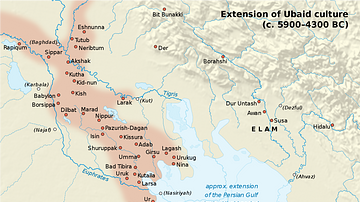
Map of Ubaid Culture
A map showing the extension of Ubaid Culture, ca. 5900 to 4300 BCE.
Image
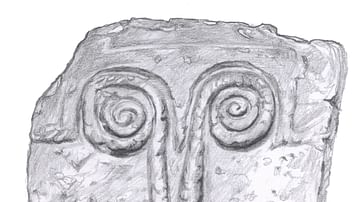
Tombstone Door (Castelluccio Culture, Sicily)
Stone door (early bronze Age, c. 2169 - c. 1500 BCE) closing of a grave dug in the rock, decorated in relief with spiral shaped motifs. On it are carved images that could allude to the sexual act and, therefore...
