
Search
Remove Ads
Advertisement
Search Results

Definition
Chinvat Bridge
The Chinvat Bridge is the span between the world of the living and the afterlife in the ancient Persian religion of Zoroastrianism. It is also known as Cinvat Bridge, Cinvad Bridge, and Chinvato Peretav. Every soul, after death...

Definition
Noah's Ark
Noah’s Ark is the boat that saved a generation of humans and animals when the God of Israel decided to destroy the human race by sending a great flood upon the earth. The story shares many elements with ancient, neighboring civilizations...

Definition
Jacob
Jacob is one of the patriarchs of ancient Judaism and the father of who became the twelve tribes of Israel. His story is told in Genesis 25-50. His Hebrew name is derived from Ya-aqob ("to supplant" or "circumvent") and is constructed...

Definition
Ancient Syria
Syria is a country located in the Middle East on the shore of the Mediterranean Sea and bordered, from the north down to the west, by Turkey, Iraq, Jordan, Israel, and Lebanon. It is one of the oldest inhabited regions in the world...

Definition
Yahweh
Yahweh is the name of the state god of the ancient Kingdom of Israel and, later, the Kingdom of Judah. His name is composed of four Hebrew consonants (YHWH, known as the Tetragrammaton) which the prophet Moses is said to have revealed...

Definition
Quran
The Quran (also written Qur’an or Koran), revealed in the 7th century, is the sacred book of Islam, following in the tradition of the Abrahamic faiths, with the Torah as the sacred book of Judaism and the New Testament as the sacred book...

Definition
Kahina
Kahina (7th century CE) was a Berber (Imazighen) warrior-queen and seer who led her people against the Arab Invasion of North Africa in the 7th century CE. She is also known as al-Kahina, Dihya al-Kahina, Dahlia, Daya, and Dahia-al-Kahina...
Definition
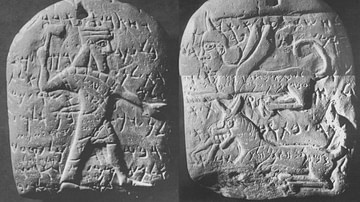
Arslan Tash Amulet
Dated to the 7th century BCE, the Arslan Tash amulet (AT1) was discovered in Arslan Tash, Syria and contains the writing of Phoenician, magic incantations. The limestone plaque includes a variety of features: incantations perceived...

Definition
Pax Mongolica - Trade and Cultural Exchange in the Mongol Empire
The Mongol Empire was the largest land empire in world history, at about 22,000,000 square kilometers (850,000 square miles). The term Pax Mongolica (Mongol Peace) refers to the way this massive...
Definition
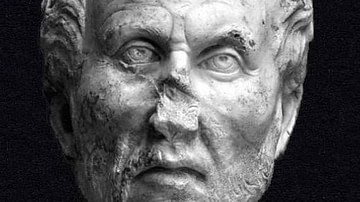
Plotinus
Plotinus (c. 204-270) was a Platonic philosopher born in Lycopolis, Egypt. Although the story of his life was written down by his student Porphyry, few biographical details are included because Plotinus rejected the physical world of...
