
Search
Remove Ads
Advertisement
Search Results

Article
Colonial Government in the Spanish Empire
The apparatus of colonial government in the Spanish Empire consisted of multiple levels, starting with the monarchy and Council of the Indies at the top and moving down to the viceroy, audiencias, mayors, and...

Definition
Storming of the Bastille
The Storming of the Bastille was a decisive moment in the early months of the French Revolution (1789-1799). On 14 July 1789, the Bastille, a fortress and political prison symbolizing the oppressiveness of France’s Ancien...

Definition
Thermidorian Reaction
The Thermidorian Reaction refers to the period of the French Revolution (1789-1799) between the fall of Maximilien Robespierre on 27-28 July 1794 and the establishment of the French Directory on 2 November 1795. The Thermidorians...

Definition
Council of the Indies
The Council of the Indies (El Real y Supremo Consejo de las Indias) operated from 1524 to 1834 and was the supreme governing body of the Spanish Empire in the Americas and Spanish East Indies. Reporting directly to the monarch...

Definition
Roman Constitution
Roman constitution was an accumulation of laws, legal decisions, and ancient customs. While today 'constitution' usually refers to a single act of legislation, this was not the case in ancient Rome. Instead, Roman government...
Definition
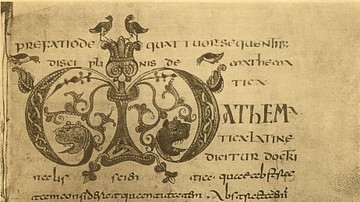
Etymologiae
The Etymologiae (Etymologies) is a Latin work by Isidore of Seville (l. c. 560 - 636 CE), compiled in the early 7th century CE and published in its final form shortly after his death. The book is a type of medieval encyclopedia and...
Definition
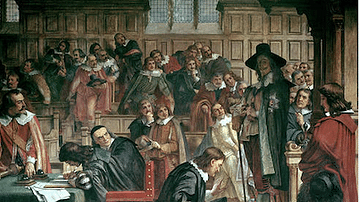
Grand Remonstrance
The Grand Remonstrance of 1641 was a list of grievances issued by Parliament against King Charles I of England (r. 1625-1649). It recorded what Parliament saw as the monarch's abuse of power, his illegal raising of taxes outside...

Definition
John Locke
John Locke (1632-1704) was an English philosopher responsible for laying the foundation of the European Enlightenment. Locke believed that each branch of government should have separate powers, that liberty must be protected from...
Definition
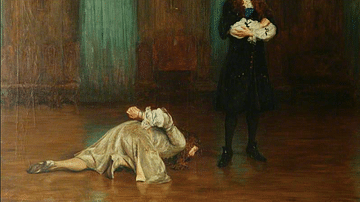
Monmouth Rebellion
The Monmouth Rebellion of June-July 1685 involved James Scott, Duke of Monmouth (1649-1685), illegitimate son of Charles II of England (r. 1660-1685), attempting to take the throne of his uncle James II of England (r. 1685-1688...

Definition
Cyrene
Cyrene (modern-day Shahhat, Libya) was a vital cultural center and port of trade in North Africa founded in 631 BCE by Greek colonists from the island of Thera. The city is best known as the birthplace of the philosopher Aristippus of...
