
Search
Remove Ads
Advertisement
Search Results
Interview
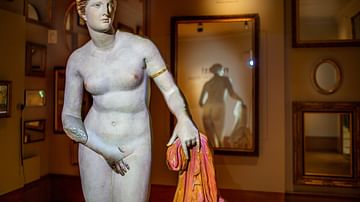
Interview: Nudity in the Ancient World
The nude figure is a universal visual theme, deeply rooted in the history of art, and it is seemingly ubiquitous in the art of the ancient civilizations of the Near East and Mediterranean. The Antikenmuseum...

Article
Sacred Cakes in Ancient Greece
Sacred cakes in ancient Greece were baked loaves, biscuits, pastries, and sponges sweetened with honey (meli) and prepared as unburnt offerings to the gods and goddesses and other divine beings. Unburnt offerings were...

Definition
Lysistrata
Lysistrata was the third and final of the peace plays written by the great Greek comic playwright Aristophanes (c. 445 - c. 386 BCE). Shown in 411 BCE at the Lenaea festival in Athens, it was written during the final years of the...

Definition
Seven Against Thebes
Seven Against Thebes is the third part of a trilogy written by one of the greatest of the Greek tragedians, Aeschylus in 467 BCE, winning first prize in competition at Dionysia. Unfortunately, only fragments of the first two...

Definition
Helen (Play)
Helen is a Greek tragedy by Euripides (c. 484-407 BCE). It is usually thought to have first been performed at the Great Dionysia of 412 BCE and was part of the trilogy that included Euripides' lost Andromeda. Helen recounts an unusual...

Definition
Symposium - The Drinking Party of Ancient Greece
The symposium (or symposion) was an important part of ancient Greek culture from the 7th century BCE and was a party held in a private home where Greek males gathered to drink, eat and sing together. Various...

Definition
Prometheus Bound
The Greek dramatist Aeschylus (c. 525 - c. 456 BCE) is considered one of the greatest tragic playwrights of his generation. He is often referred to as the “Father of Greek Tragedy.” Older than both Sophocles and Euripides, he...

Definition
Mythology
Myths are a part of every culture in the world and are used to explain natural phenomena, where a people came from and how their civilization developed, and why things happen as they do. At their most basic level, myths comfort by...

Article
Museums in the Ancient Mediterranean
Museums have been around much longer than one might think, but in the ancient world, they were principally institutions of research and learning rather than places to display artworks and artefacts, even if they...

Collection
The Art & Culture of Ancient Greece
The ancient Greeks were masters at picking up ideas from other cultures, mixing these with their own innovations and producing unique contributions to world culture. Greek sculptors adored the human form, painters...
