
Search
Did you mean: Greek Fire?
Remove Ads
Advertisement
Search Results

Definition
Nyx
Nyx (also known as Nox or the Night) is the personification of the night in Greek mythology. Coming from Chaos (Void), Nyx is a primordial deity (Protogenoi). The Protogenoi represent the physical and elemental forces of the world and consist...

Definition
Roman Medicine
Roman medicine was greatly influenced by earlier Greek medicine and literature but would also make its own unique contribution to the history of medicine through the work of such famous experts as Galen and Celsus. Whilst there...

Definition
Sappho of Lesbos
Sappho of Lesbos (l. c. 620-570 BCE) was a lyric poet whose work was so popular in ancient Greece that she was honored in statuary, coinage, and pottery centuries after her death. Little remains of her work, and these fragments...
Definition
Dionysos
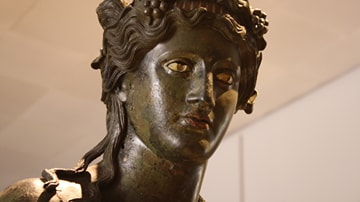
Dionysos (Roman name: Bacchus, also known as Dionysus) was the ancient Greek god of wine, merriment, and theatre. Being the bad boy of Mt. Olympus, Dionysus was perhaps the most colourful of the Olympian Gods. Son of Zeus In Greek...

Definition
Magna Graecia
Magna Graecia (Megalē Hellas) refers to the coastal areas of southern Italy which were colonized by various ancient Greek city-states from the 8th to 5th centuries BCE. Sicily, although also a region of Greek colonization, is not...

Definition
Philosophy
The word philosophy comes from the Greek philo (love) and sophia (wisdom) and so is literally defined as “the love of wisdom”. More broadly understood, it is the study of the most basic and profound matters of human existence. Philosophical...

Definition
Miltiades
Miltiades (c. 555-489 BCE) was the Athenian general who defeated the Persians at the Battle of Marathon in 490 BCE. The Greeks faced a Persian force of superior numbers led by the commanding admiral Datis, who had been sent by their...
Definition
Britomartis
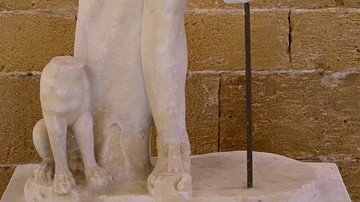
Britomartis, also known as Diktynna (Dictynna), was the Cretan goddess of hunting and fishing nets in Greek mythology. Although referred to as a nymph and worshipped locally, she had at least two significant and active shrines, one...

Definition
Agamemnon (Play)
The play Agamemnon was written by one of the greatest Greek tragedians Aeschylus (c. 525 – 455 BCE), “Father of Greek Tragedy.” Older than both Sophocles and Euripides, he was the most popular and influential of all tragedians...

Definition
Medea (Play)
The tragedy Medea was written in 431 BCE by Euripides (c. 484 – 407 BCE). Euripides authored at least 90 plays of which 19 have survived intact. As with the plays by Sophocles and Aeschylus, the audience was already well aware of...
