
Search
Did you mean: Trireme?
Remove Ads
Advertisement
Search Results

Definition
Pantheon - Rome's Best-Surviving Building
The Pantheon (Latin: pantheum) is the best-preserved building from ancient Rome and was completed in c. 125 CE. Its magnificent concrete dome is a lasting testimony to the genius of Roman architects. As the...

Definition
Acropolis
An acropolis is any citadel or complex built on a high hill. The name derives from the Greek akro, "high" or "extreme/extremity" or "edge", and polis, "city", translated as "high city", "city on the edge" or "city in the air", the...

Definition
Edgar Degas
Edgar Degas (1834-1917) was a French impressionist painter who used many different media to capture dancers, bathers, horse races, and scenes from Parisian café society. A keen photographer, Degas' paintings frequently show real-life...

Definition
Phoenician Art
The art of the ancient Phoenicians, which flourished between the 19th and 4th centuries BCE, was exported throughout Mesopotamia and the ancient Mediterranean. Best known for their work on small decorative objects, Phoenician artists...

Definition
Samothrace
Samothrace (Samothrake) is a Greek island in the northern Aegean which was prominent from the Classical period as a member of the Delian League. Its greatest claim to fame was as a cult centre favoured by Macedon and visited by pilgrims...

Definition
Tarquinia
Tarquinia (Etruscan name: Tarch'na or Tarch, Roman name: Tarquinii) is a town located on the western coast of central Italy which was an important Etruscan and then Roman settlement. It is famous today as the site of around 200 Etruscan...

Article
Etruscan Tomb Paintings
The Etruscans flourished in central Italy from the 8th to 3rd century BCE, and one of their greatest legacies is the beautifully painted tombs found in many of their important towns. Tarquinia, Cerveteri, Chiusi, and Vulci...
Article
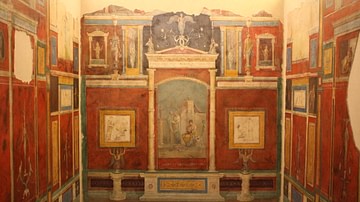
Roman Wall Painting
The interiors of Roman buildings of all description were very frequently sumptuously decorated using bold colours and designs. Wall paintings, fresco and the use of stucco to create relief effects were all commonly used by...

Article
Visitor's Guide to Ancient Dion
Dion is located at the foot of Mount Olympus in the north of Greece, in what would have been ancient Macedon. It takes its name from the most important Macedonian sanctuary dedicated to Zeus ("Dios” meaning "of Zeus”...

Article
The Tizoc Stone
The Tizoc Stone is a huge stone cylinder from the Aztec capital of Tenochtitlan which depicts a sun-disk on its flat upper surface and carries a frieze around its outer edge showing Aztec warriors and the Aztec king Tizoc, whose...
