
Search
Did you mean: Trireme?
Remove Ads
Advertisement
Search Results

Image
Abu Simbel, Facade of the Temple of Ramesses II
The Great Temple at Abu Simbel was built by Ramesses II and completed around 1264 BCE. It stands 98 feet (30 metres) high and 115 feet (35 metres) long with four seated colossi flanking the entrance, two...

Image
Young Spartans Exercising by Degas
A c. 1861 oil on canvas painting, Young Spartans Exercising, by Edgar Degas (1834-1917), the French impressionist painter. A typical early work of the artist when he was still interested in becoming a historical...

Image
Sir James Douglas
Sir James Douglas, aka 'Black Douglas' (c. 1286-1330 CE), a Scottish knight who fought for his country's independence from England. He is here shown with fellow fighters Robert Bruce and William Wallace. (Entrance hall frieze...
Image
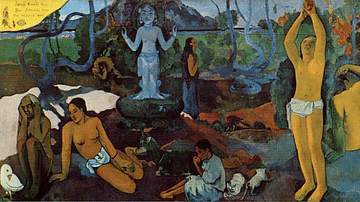
Where Do We Come From? What are We? Where Are We Going? by Gauguin
An 1897 oil on canvas, Where Do We Come From? What are We? Where Are We Going?, by Paul Gauguin (1848-1903), the French post-impressionist painter. This huge frieze-like canvas measures...

Image
Vix Krater
The Vix Krater, a massive Greek krater, or wine-mixing vessel, found in Vix, France. This massive, 1.63 m (5'4") high bronze vessel weighs around 200kg (450lbs), making it the largest Classical Greek bronze vessel found to date. The...

Image
Hagia Triada Sarcophagus
The Hagia Triada sarcophagus is a Late Bronze Age (1400 BCE) 137 cm-long limestone sarcophagus covered in plaster and painted in fresco and combining features of Minoan and Mycenaean style. The painted frieze shows all...

Image
Stone-carved Medusa head from the temple of Apollo at Didyma
This giant Medusa head was formerly part of a frieze on the architrave of the Apollo Temple at Didyma (Turkey).

Image
Gods Fighting Giants, Delphi
A detail from the frieze of the Treasury of the Siphians at Delphi depicting the Gods fighting the Giants (525 BCE), Delphi Archaeological Museum.

Image
Temple Ritual Scene from Hatra
This limestone slab was carved in prominent sunken relief and depicts a temple ritual scene. A male figure wearing the head cap of Hatrene kings (very probably Sanatruq I who reigned c. 140 - 180 CE), holds a small...
Image
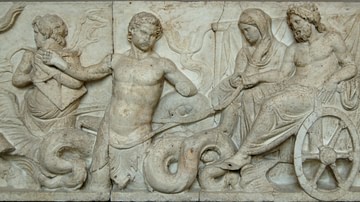
The Wedding of Poseidon & Amphitrite
Poseidon and Amphitrite in the bridal carriage, drawn by two Tritons playing music, on the 'Altar of Domitius Ahenobarbus' or 'Statue Base of Marcus Antonius', relief frieze of a monumental statue group base, 2nd...
