
Search
Remove Ads
Advertisement
Search Results

Article
The Three Estates of Pre-Revolutionary France
Society in the Kingdom of France in the period of the Ancien Regime was broken up into three separate estates, or social classes: the clergy, the nobility, and the commoners. These classes and their accompanying power dynamics, originating...
Definition
Gisela of France
Gisela of France was a legendary 10th-century CE Francian princess, who, according to tradition, was married off to Viking leader Rollo of Normandy. Her name, Gisela or Gisla, comes from an Old German word meaning "to pledge", the French...

Definition
Hundred Years' War
The Hundred Years' War (1337-1453) was an intermittent conflict between England and France lasting 116 years. It began principally because King Edward III (r. 1327-1377) and Philip VI (r. 1328-1350) escalated a dispute over feudal rights...
Image
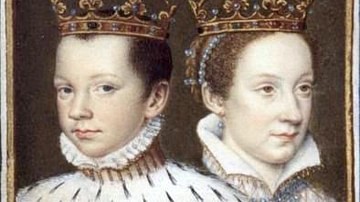
Mary, Queen of Scots & Francis II of France
A c. 1559 illustration of Mary, Queen of Scots (r. 1542-1567) and her first husband, Francis II of France (r. 1559-1560).
National Library of France, Paris.

Article
France’s 1905 Law of Separation of Church and State
The 1905 Law of Separation of Church and State was enacted as the climax of decades of conflict between monarchists and anticlerical Republicans who viewed Christianity as a permanent obstacle to the social development of the Republic. The...
Article
The Dreyfus Affair & the Separation of Church and State in France
The Dreyfus Affair, or L'Affaire as it has become known, demonstrated the competing forces at work to either reestablish the monarchy and the Church in power or to solidify and advance the unfulfilled ideals of the 1789 French Revolution...
Definition
Michel de L'Hospital
Michel de L'Hospital (also known as L'Hôpital, c. 1505-1573) was a French statesman who served during the reigns of four kings – Francis I, Henry II, Francis II, and Charles IX – as Councillor of Parlement (1537), Chancellor of the Duchesse...

Article
French Involvement in the American Revolution
The involvement of France in the American War of Independence (1775-1783) was not only significant in the progress of the war itself but also as a critical moment for France. Whereas French intervention in the war would help turn the tide...

Article
The Ancient Celtic Pantheon
The ancient Celtic pantheon consisted of over 400 gods and goddesses who represented everything from rivers to warfare. With perhaps the exception of Lugh, the Celtic gods were not universally worshipped across Iron Age Europe but were very...

Article
Architects of France's 1901 Law of Associations
The Law of Associations was adopted by the French Parliament on 3 July 1901 to limit the influence of Catholic teaching orders as the first step toward the formal separation of church and state that would follow in 1905. Of 16,904 religious...
