
Search
Remove Ads
Advertisement
Search Results
Definition
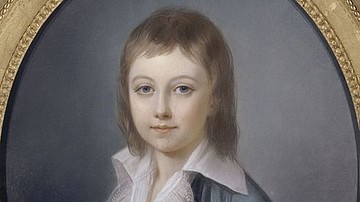
Louis XVII of France
Louis XVII of France was the regnal name of Louis-Charles de France (l. 1785-1795), the younger son of King Louis XVI of France (r. 1774-1792) and Queen Marie Antoinette (l. 1755-1793). Although Louis-Charles never actually reigned as king...
Definition
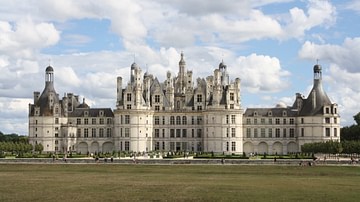
Château de Chambord
The Chateau de Chambord, located in the Loire Valley of Loir-et-Cher, France, was built between 1519 and 1547 CE. This fine French Renaissance building, although impressive in both size and architectural detail, was commissioned by Francis...

Article
Francis Drake's Circumnavigation of the Globe
The English mariner, privateer, and explorer Francis Drake (c. 1540-1596 CE) made his circumnavigation of the world between 1577 and 1580 CE. Only the second to achieve this feat after the expedition of the Portuguese explorer Ferdinand Magellan...

Definition
Louis I de Bourbon, Prince of Condé
Louis I de Bourbon (l. 1530-1569) was a descendant of Louis IX of France (r. 1226-1270) and founder of the House of Condé. The Prince of Condé proved his valor as a Huguenot military leader during the first three French Wars of Religion and...

Definition
Charles VI of France - The Mad King
Charles VI (lived 1368-1422) reigned as King of France from 1380 to 1422, during an important phase of the Hundred Years' War (1337-1453) against England. Known as the 'Mad King' due to his frequent bouts with psychosis, Charles often had...

Definition
Château d'Amboise
The Château d'Amboise, located in the Loire Valley, in central France, was built over several centuries and was the centre of royal power during the Renaissance (from the 15th to the early 17th century). Witness to the heyday of the French...

Definition
St. Bartholomew's Day Massacre
The St. Bartholomew's Day Massacre was a widespread slaughter of French Protestants (Huguenots) by Catholics beginning on 24 August 1572 and lasting over two months, resulting in the deaths of between 5,000 and 25,000 people. It began in...

Article
Henry IV of France & the Edict of Nantes
Henry of Navarre became the nominal ruler of France after the assassination of Henry III of France (r. 1574-1589), whose marriage to Louise de Lorraine produced no heir. After years of attempts to deny the throne to Navarre, his enemies realized...

Definition
Marie de France
Marie de France (wrote c. 1160-1215 CE) was a multilingual poet and translator, the first female poet of France, and a highly influential literary voice of 12th-century CE Europe. She is credited with establishing the literary genre of chivalric...

Article
Why Did Britain & France Appease Hitler?
The policy of appeasement towards the demands of Adolf Hitler (1889-1945) regarding Nazi Germany's territorial expansion ultimately failed when the Second World War (1939-45) began. The reasons appeasement was adopted by Britain and France...
