
Search
Remove Ads
Advertisement
Search Results
Image
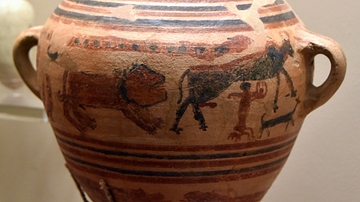
Pottery Jar Showing a Myth from Tell Zar'a
Lare jar painted in red and black on beige. The paintings show animal scenes in two registers. In the lower register, two large snakes lie opposite each other. In the upper one, framed by horizontal lines...

Image
Myth of Iphigenia Mosaic, Empuries
A Roman floor mosaic emblemata depicting the myth of Iphigenia and her (almost) sacrifice by Agamemnon, her father, prior to the Trojan War. From a Roman villa, Empuries, 1st century BCE. (Archaeological Museum...
Image
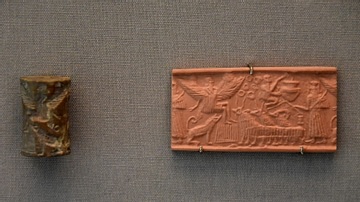
Myth of Etana Cylinder Seal
This calcite cylinder seal depicts the myth of Etana, the shepherd and the legendary king of Uruk, who was carried up to heaven by an eagle to obtain an heir. Etana's ascent is watched by the shepherd and his dog, with...

Definition
Eridu - The Divine Birthplace of Kingship and Order
Eridu (present-day Abu Shahrein, Iraq) was considered the first city in the world by the ancient Sumerians and is among the most ancient of the ruins from Mesopotamia. Founded circa 5400 BCE, Eridu...

Article
The Instructions of Shuruppag - Ancient Philosophical Wisdom
The Instructions of Shuruppag (circa 2500/2000 BCE) is the most famous work of the genre of Sumerian wisdom literature whose purpose was to encourage proper behavior in conformity with cultural...

Article
Ten Juneteenth Myths
The celebration of Juneteenth – originally known as "Freedom Day" – began on 1 January 1866 in Texas and, since then, a number of myths have grown up around the event it commemorates: the issuance of General Order No. 3 in...

Definition
Sumerians - Inventors of Civilization
The Sumerians were the people of southern Mesopotamia (modern-day southern Iraq) whose civilization flourished between circa 4000 and 1750 BCE. Their name comes from the region, which is frequently – and incorrectly...
Definition
Ganymede
Ganymede (pronounced GAH-nuh-meed) is a youth in Greek mythology who is abducted by Zeus because of his great beauty and brought to Mount Olympus to serve as cupbearer. The story first appears in Homer’s Iliad without any suggestion...

Definition
Nephthys
Nephthys was one of the original five gods of ancient Egypt born of the union of Geb (earth) and Nut (sky) after the creation of the world. She was the fourth born after Osiris, Isis, and Set and was the older sister of Horus (usually...

Definition
Enlil - Mesopotamian Keeper of the Tablets of Destiny
Enlil (also known as Ellil and Nunamnir) was the Sumerian god of the air in the Mesopotamian pantheon, but he was more powerful than any other elemental deity and eventually was worshiped as King of...
