
Search
Remove Ads
Advertisement
Search Results

Definition
Daniel Morgan
Daniel Morgan (l. c. 1735-1802) was an American frontiersman and soldier, most famous for leading a corps of riflemen during the American Revolutionary War (1775-1783). He rose to the rank of brigadier general in the Continental...

Definition
Ptolemaic Navy
Ptolemaic Egypt was a naval power that exerted influence throughout the Eastern Mediterranean from its foundation in 330 BCE until Cleopatra's defeat by Augustus at the Battle of Actium in 30 BCE. The Ptolemaic Kingdom produced...

Definition
Islam
Islam is an Abrahamic-monotheistic religion based upon the teachings of Prophet Muhammad ibn Abdullah (l. 570-632 CE, after whose name Muslims traditionally add “peace be upon him” or, in writing, PBUH). Alongside Christianity and Judaism...

Definition
Homo Naledi
Homo naledi is an extinct species of human discovered in Rising Star Cave in South Africa in 2013 CE in what has become the biggest single-species hominin find in Africa to this day, which is moreover set to cause a bit of an avalanche...

Definition
Paul Cézanne
Paul Cézanne (1839-1906) was a French post-impressionist artist. Although he struggled for recognition in his own lifetime and often lacked confidence in his work, the artist's unique style, use of light and colour, and his interest...

Definition
Camille Pissarro
Camille Pissarro (1830-1903) was an impressionist painter based in France who focussed on landscapes but frequently changed his style and subjects. He was an instrumental figure in the new art movement of the 19th century, organising...

Definition
Gezer
Gezer is an ancient city and archaeological site located in central Israel where the central mountains meet the northern Shephelah, about 10 km southeast of the city of Ramleh. According to the Hebrew Bible, Gezer was one of the great...

Definition
Labyrinth
The word labyrinth comes from the Greek labyrinthos and describes any maze-like structure with a single path through it which differentiates it from an actual maze which may have multiple paths intricately linked. Etymologically the...
Definition
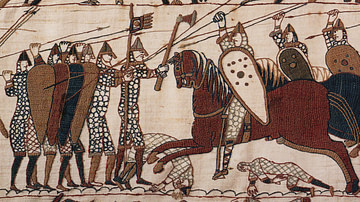
Battle of Hastings
The Battle of Hastings in south-east England on 14 October 1066 saw the defeat of the Anglo-Saxon king Harold II (r. Jan-Oct 1066) by the invading Norman army led by William, Duke of Normandy (reigned from 1035). After a day...

Definition
Harold Godwinson
Harold Godwinson (also spelt Godwineson) reigned briefly as King Harold II of England from January to October 1066 CE, the momentous year which witnessed the Norman conquest and end of 500 years of Anglo-Saxon rule. Harold had...
