
Search
Remove Ads
Advertisement
Search Results
Image
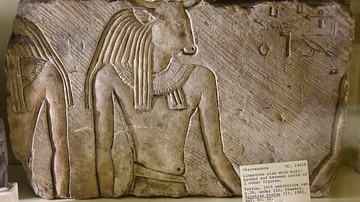
Egyptian Bull-headed deity
This limestone wall-relief block depicts a bull-headed god; the god has a human body and looks to the right side. He is standing between parts of two other partially shown figures. The background wall was left rough. From...

Video
Anubis: The Egyptian Jackal-Headed God of Mummifaction and the Afterlife
Anubis is the jackal-headed Egyptian god of mummification and the afterlife. He is depicted both as a jackal, and as a man with the head of a jackal. Anubis as a man is often depicted...
Image
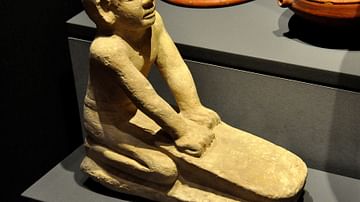
Statue of an Ancient Egyptian Servant
Limestone statue of an Egyptian servant grinding flour. From modern-day Egypt. Old Kingdom, 6th Dynasty, 2250 BCE. (State Museum of Egyptian Art, Munich, Germany).

Image
Egyptian Relief showing a butcher and an ox
This limestone fragment of a stela or a block from chapel wall depicts a butcher who cuts up a leg of beef. At the upper part, there is a pile of meat. Some of the the hieroglyphic inscriptions read "meat...
Image
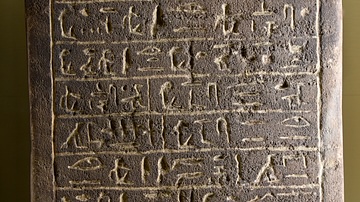
Egyptian stela of Sehetepibre and others
On this sandstone stela, there are 10 lines of hieroglyphs inside the border line. The stela mentions the name of the guard of the bureau of fields, Sehetepibre (born of Ite). From the Tombs of The Courtiers...

Image
Egyptian Broad Collar
Egyptian broad collar in faience. The broad collar is one of the most characteristic elements of ancient Egyptian jewellery. Called wesekh, which means 'the broad one', broad collars are often made up of different rows of...
Image
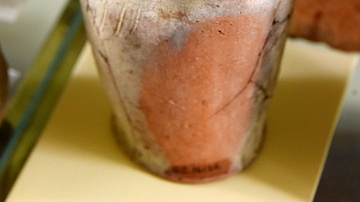
Egyptian Pot in the form of a Mourning Woman
This is a hollow pottery statuette. It depicts a woman mourning; she holds her hands to her head. The statuette is red with a white slip (inverted). From Dandera, Egypt. 11th Dynasty, 2061–1991 BCE. The...

Article
Cosmetics, Perfume, & Hygiene in Ancient Egypt
For the ancient Egyptians life was a celebration, and so, just as one would want to look one's best at any party, personal hygiene was an important cultural value. The Egyptians bathed daily, shaved their...

Article
The Art of the Amarna Period
Of all the pharaohs who ruled ancient Egypt, there is one in particular that stands out from the rest. Over the course of his 17-year reign (1353-1336 BCE), Akhenaten spearheaded a cultural, religious, and artistic revolution...

Definition
The Ankh
The Ankh is one of the most recognizable symbols from ancient Egypt, known as "the key of life" or "cross of life" and dated to the Early Dynastic Period (c. 3150 - 2613 BCE). It is a cross with a loop at the top sometimes ornamented...
