
Search
Remove Ads
Advertisement
Search Results

Image
Egyptian Fish Coffin
A wooden coffin shaped in the form of a Nile bolti fish and containing the mummified remains of a fish. Dynasty XXX-XXXI, 4th century BCE. (Egytpian Museum, Turin)

Image
Ancient Egyptian Offering Basin
This offering basin made from stone dates from the time that Egypt was a province of the Roman Empire (30 BCE–641 CE). It was carved in the shape of an ankh, which symbolized life. (Musée du Cinquantenaire, Brussels...

Image
Portion of an Ancient Egyptian Stela
This stela is from the tomb of Espotu, a priest of Amun-Re and son of the second prophet of Amun-Re, Ankhefenkhons. In the inscription, he lists the 22 priesthoods he held, detailing his received a salary for each...
Image
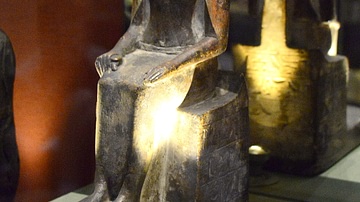
Statue of Egyptian Priest Senemiah
The inscriptions on the sides identify the man as Senemiah, a priest of the Theban moon-god Khons, with the unsual phrase "he whose hands are pure when adorning his god," referring to the daily ritual in which the...

Image
Fractured Femur of an Egyptian Mummy
This right femoral bone shows evidence of malunion and misalignment of a healed fractured. From Abydos, Egypt. Late Period, after 664 BCE. (The British Museum, London)

Image
Egyptian King-list
Monumental lists of past kings expressed the living ruler's legitimacy. Originally, Ramesses II was shown on the far right, honoring previous kings and the god Osiris. The kings were represented by their throne names, written...
Image
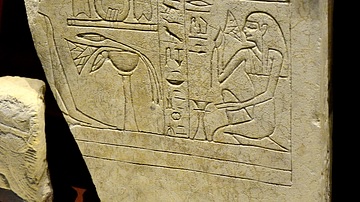
Egyptian Stela Showing Women Sitting Before Offerings
This fragment of a stela shows two women before tablets of offerings. From Abydos, Late Middle Kingdom, circa 1750 BCE. (National Museum of Ireland-Archaeology, Dublin, Republic of Ireland)

Image
Male Egyptian Mummy with Amulets
This unidentified man was wrapped in a painted and inscribed shroud and provided with small amulets of gilded wood, threaded on a frame. From Egypt. Roman Period, after 30 BCE. (The British Museum, London)

Image
Egyptian Book of the Dead Fragment
Fragment of a linen mummy shroud with texts from the Book of the Dead, written in ink. From Thebes, Egypt. 18th Dynasty, circa 1500 BCE.
Image
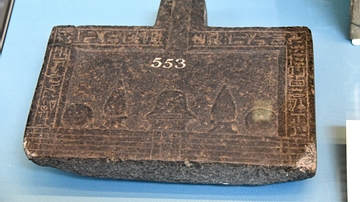
Egyptian Offering table of Amenemhat
The surface of this black granite offering table is carved in relief with images of food and drink offerings. From Egypt. 12th or 13th Dynasty, circa 1985-1750 BCE. (The British Museum, London)
