
Search
Remove Ads
Advertisement
Search Results
Definition
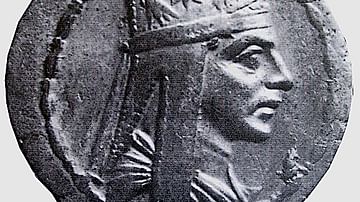
Tigranes the Great
Tigranes II or Tigranes the Great ruled as the king of Armenia from c. 95 to c. 56 BCE. Expanding in all directions, at its peak, Tigranes' Armenian Empire stretched from the Black Sea to the Mediterranean. Not before or since would Armenians...

Definition
Artaxiad Dynasty
The Artaxiad (Artashesian) dynasty ruled ancient Armenia from c. 200 BCE to the first decade of the 1st century CE. Founded by Artaxias I, the dynasty would ensure Armenia enjoyed a sustained period of prosperity and regional importance...

Definition
Artaphernes
Artaphernes (active c. 513-492 BCE, also known as Artafarna) was the satrap of Lydia under the reign of his older brother Darius I (the Great, r. 522-486 BCE), monarch of the Achaemenid Empire (c. 550-330 BCE) which was founded by Cyrus II...

Article
Inventions & Innovations of Ancient Persia
Ancient Persian culture contributed many of the aspects of the modern world which people take for granted as having always existed. The designation “Persia” comes from the Greeks – primarily from the historian Herodotus – but the people of...
Article
Twelve Great Women of Ancient Persia
Women in ancient Persia had more rights and greater freedom than any other ancient civilization including, according to some scholars, even ancient Egypt which is famous for its respect for the feminine principle in religion as well as daily...

Article
Death of Alexander the Great
In June of 323 BCE, Alexander the Great (r. 336-323 BCE) died in Babylon. His sudden death before his 33rd birthday has long been a point of speculation: was it disease, old wounds, or murder? Regardless of the cause, history ranks him as...

Article
History of Assyria
The foundation of the Assyrian dynasty can be traced to Zulilu, who is said to have lived after Bel-kap-kapu (c. 1900 BCE), the ancestor of Shalmaneser I. The city-state of Ashur rose to prominence in northern Mesopotamia, founding trade...

Article
Bureaucracy in the Achaemenid Empire: Learning from the Past
In the early days of the Achaemenid Empire (c. 550-330 BCE), the kings came to realise that, if they were to be able to administer the vast mass of land and the multicultural people who inhabited it, they had to create an organizational system...
Article
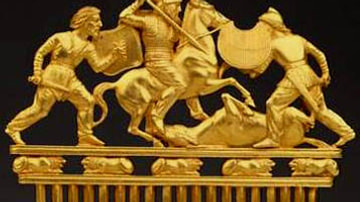
Parthian-Scythian Relations
While little is written about Parthian-Scythian relations, not only did the Parthians share origins with the Scythians and cooperated militarily but social, cultural, and commercial interactions were likely as well. Essentially leading a...

Image
Ranks of Immortals
Ranks of the Louvre Museum melophores (immortal Persian guard) from the famous glazed bricks friezes found in the Apadana (Darius the Great's palace) in Susa by archeologist Marcel Dieulafoy and brought to Paris. Such polychromic friezes...
