
Search
Remove Ads
Advertisement
Search Results

Definition
Aedile
The aedile was an official of the Roman Republic who maintained Roman roads, supervised the grain and water supply, and provided the city's citizens with games among other duties. Initially, they were plebeian and elected annually by...

Definition
Battle of the Granicus
The Battle of the Granicus in May 334 BCE was Alexander the Great's (356-323 BCE) first major victory against the forces of the Achaemenid Empire. Alexander had crossed the Hellespont with his combined Macedonian and Greek...

Definition
Cerveteri
Cerveteri (Etruscan name: Cisra or Caisra, Greek: Agylla, Roman: Caere) was an important Etruscan town which flourished between the 7th and 4th century BCE. Located near the western coast of central Italy, around 50 km north of Rome...

Definition
Luoyang - Ancient Chinese Capital
Luoyang (aka Loyang) was the capital city of many ancient Chinese dynasties, a position it frequently swapped with Chang'an, usually whenever there was a change of dynasty. Located in the Henan province in the eastern...

Definition
Persis
Persis (in Greek, derived from Persian pars) is the ancient name of the approximate area of modern Fars in Central Iran, as well as a state of the Hellenistic and Imperial periods in this same province. Its name is derived from the Persians...
Definition
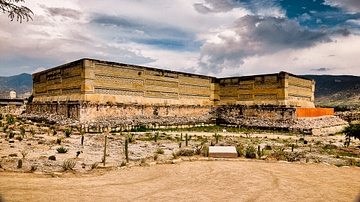
Mitla
Mitla, located in the eastern portion of the Valley of Oaxaca in southern Mexico, was an important site of the Zapotec civilization. Gaining prominence from the early Post-Classic period (c. 700-900 CE), Mitla became the most important...

Definition
Anahita
Anahita is the ancient Persian goddess of fertility, water, health and healing, and wisdom. Owing to her association with life-giving properties, she also came to be connected with ancient Persian warfare as soldiers would pray to her...

Definition
Egyptian Obelisk
An obelisk is a stone rectangular pillar with a tapered top forming a pyramidion, set on a base, erected to commemorate an individual or event and honor the gods. The ancient Egyptians created the form at some point in the Early...

Definition
Byzantine Coinage
The coinage of the Byzantine Empire continued that of its more ancient predecessors and functioned as a convenient method of payment for goods and services, especially to soldiers and officials, and as a means for people to pay...

Definition
Knights Templar
The Knights Templar were established c. 1119 and given papal recognition in 1129. It was a Catholic medieval military order whose members combined martial prowess with a monastic life to defend Christian holy sites and pilgrims...
