
Search
Did you mean: Tyre?
Remove Ads
Advertisement
Search Results

Definition
Picts
The Picts were a people of northern Scotland who are defined as a "confederation of tribal units whose political motivations derived from a need to ally against common enemies" (McHardy, 176). They were not a single tribe, nor necessarily...

Definition
Yamm
Yamm (from the Semitic word yam for 'sea', also known as Yam and Yam-Nahar) was the god of the sea and storm in the pantheon of the Canaanite-Phoenicians. Depicted consistently as tyrannical, angry, violent, and harsh, Yamm was the brother...

Definition
Cleopatra Selene II
Cleopatra Selene II (40 - c. 5 BCE) was a member of the Ptolemaic Dynasty who became the queen of Mauretania upon her marriage to King Juba II of Numidia (48 BCE - 23 CE). Though more obscure than her famous mother, Cleopatra...

Definition
Samudragupta
Samudragupta (r. 335/350 - 370/380 CE) was the first significant ruler of the Gupta Dynasty. Having come to the throne, he decided to extend the boundaries of his empire to cover the multiple kingdoms and republics that existed outside...

Definition
Tarentum
Tarentum (Taras, modern Taranto), located on the southern coast of Apulia, Italy, was a Greek and then Roman city. Controlling a large area of Magna Graecia and heading the Italiote League, Tarentum, with its excellent harbour, was...

Definition
Arachne
Arachne, from the Greek arákhnē (meaning spider), is a figure in Greek mythology whose talent for weaving was renowned and who famously challenged the goddess Minerva to a weaving competition. As told in Ovid’s (43 BCE-17 CE) Metamorphoses...

Definition
Juba II
Juba II (c. 48 BCE - 23 CE) was a Numidian prince and the king of Mauretania from c. 25 BCE until his death in 23 CE. He was raised in the household of Julius Caesar (c. 100-44 BCE) and married Cleopatra Selene II (40 - c. 17/5 BCE...

Definition
Chandragupta II
Chandragupta II (c. 375 CE - 413/14 CE) was the next great Gupta emperor after his father Samudragupta (335/350 - 370/380 CE). He proved to be an able ruler and conqueror with many achievements to his credit. He came to be known...
Definition
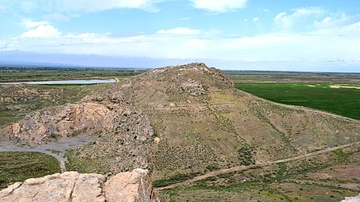
Artashat
Artashat (aka Artaxata) was the capital of Ancient Armenia from 176 BCE and remained so for over 300 years of the kingdom's history. Located just south of Armenia's modern capital Yerevan, according to the ancient historian Plutarch...

Definition
Ptolemy of Mauretania
Ptolemy of Mauretania (r. 23-40 CE) was king of Mauretania and one of the last surviving members of the Ptolemaic dynasty. His father Juba II (c. 48 BCE to 23 CE) was a Numidian royal and his mother Cleopatra Selene II (40...
