
Search
Remove Ads
Advertisement
Search Results

Article
Dogs in Ancient Persia
Dogs have been an integral aspect of the human condition in virtually every world culture for thousands of years. Some of the greatest civilizations of the past have kept dogs as companions, for various chores, and featured...
Article
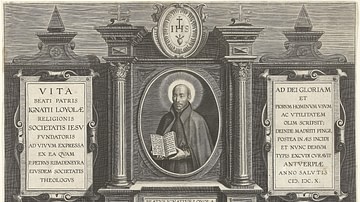
Autobiography of Saint Ignatius of Loyola
The Autobiography of Saint Ignatius is the story of the life of Ignatius of Loyola (l. 1491-1556) dictated by him to the Jesuit priest Father Louis Gonzalez between 1553-1555, shortly before Loyola's death...
Article
Interview: Dr. Bastian Eclercy on Guido Reni at the Städel Museum, Frankfurt
Misunderstood, neglected, forgotten. The Städel Museum in Frankfurt, Germany is rediscovering one of the star painters of the Italian Baroque in a landmark exhibition: GUIDO RENI...

Article
The Temple of Hatshepsut
Among the duties of any Egyptian monarch was the construction of monumental building projects to honor the gods and preserve the memory of their reigns for eternity. These building projects were not just some grandiose...

Article
Alexander the Great as a God
The age-old concept of the “divine right of kings” allowed that a country's ruler received his or her power or authority from God. However, few, if any, were delusional enough to actually believe themselves to be a god...

Article
Ten Great Persian Poets
Persian literature derives from a long oral tradition of poetic storytelling. The first recorded example of this tradition is the Behistun Inscription of Darius I (the Great, r. 522-486 BCE), carved on a cliff-face c. 522...

Article
Luther's 97 Theses
Martin Luther's 95 Theses, credited with sparking the Protestant Reformation in Europe, have become a cultural touchstone since he posted them 31 October 1517, but the little-known 97 Theses, posted only a month earlier, are...

Article
The Ancient Concept of a Noble Death
The act of voluntary death was never condemned in antiquity. In fact, The English word "suicide" comes from the Latin for "self-slaying." The reason for a voluntary death had to be one that was honorable and necessary...

Article
Unam Sanctam: Spiritual Authority & the Medieval Church
The Unam Sanctam (1302) was a papal bull issued by Pope Boniface VIII (served 1294-1303) requiring the complete submission of all people, including kings, to the authority and dictates of the pope...

Article
The Mandate of Heaven and The Yellow Turban Rebellion
Throughout history, in order for a government to be respected and obeyed, it must possess some form of legitimacy recognized by the governed. Governmental systems have relied on a number of models...
