
Search
Remove Ads
Advertisement
Search Results

Article
Gothic Cathedrals: Architecture & Divine Light
Gothic cathedrals are some of the most recognizable and magnificent architectural feats. With soaring towers and softly filtered light streaming through stained glass windows, everything about the Gothic...

Article
The Women of Athena's Cult
In ancient Athens, women had no life outside the home unless they were prostitutes or were engaged in religious activities such as festivals. Every Greek deity in every city-state had their own cult (sect) but the cult...

Article
Sulla's March on Rome
In 88 BCE, Lucius Cornelius Sulla (138-78 BCE) marched on Rome and entered the city's sacred inner boundary, the pomerium, bearing arms. Breaking this taboo, he sought to gain political power and control of the army of the...
Article
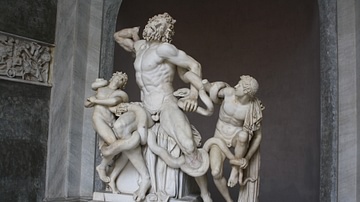
Laocoön: The Suffering of a Trojan Priest & Its Afterlife
The sculpture group of Laocoön and His Sons, on display in the Vatican since its rediscovery in 1506, depicts the suffering of the Trojan prince and priest Laocoön (brother of Anchises) and his...

Article
A Visitor's Guide to Herculaneum
In the first part of our new travel series devoted to the archaeological sites around the Bay of Naples, we shared some hints and tips as to how you can best prepare for your self-guided tour of Pompeii. In this second...

Article
Etruscan Society
The social organisation of the ancient Etruscans, a civilization which flourished in central Italy between the 8th and 3rd century BCE, can only be pieced together from a collection of rather unsatisfactory sources which, unfortunately...
Article
Etruscan Trade
The Etruscan civilization flourished in central Italy between the 8th and 3rd century BCE, and their prosperity was largely based on their exploitation of local mineral resources, both through manufactured goods and trade. The...

Article
Roman Warfare in the Age of Pyrrhus
The Roman army fought many conflicts throughout its long history, though perhaps none so indelible as the Pyrrhic War from 280 to 275 BCE. This war between Rome and a league of Greek colonies in southern Italy...

Article
Unam Sanctam: Spiritual Authority & the Medieval Church
The Unam Sanctam (1302) was a papal bull issued by Pope Boniface VIII (served 1294-1303) requiring the complete submission of all people, including kings, to the authority and dictates of the pope...

Article
Pherenike the Female Olympic Trainer
Pherenike (l. c. 388 BCE, also known as Kallipateira) was an athlete from Rhodes who, because she was a woman, could not compete in the Olympic Games and, as a married woman, was not allowed to even watch them...
