
Search
Remove Ads
Advertisement
Search Results

Definition
Honoré-Gabriel Riqueti, comte de Mirabeau
Honoré-Gabriel Riqueti, comte de Mirabeau (l. 1749-1791) was a French orator and nobleman who rose to prominence as a leader during the early stages of the French Revolution (1789-1799). From the disgraced...

Definition
Reign of Terror
The Reign of Terror, or simply the Terror (la Terreur), was a climactic period of state-sanctioned violence during the French Revolution (1789-99), which saw the public executions and mass killings of thousands of counter-revolutionary...

Definition
Ptolemy II Philadelphus
Ptolemy II Philadelphus ("The Sibling Loving", r. 282-246 BCE) was the second ruler of the Ptolemaic Dynasty. He consolidated the kingdom conquered by his father Ptolemy I and presided over its golden age. Ptolemy II invested...

Definition
German East Africa
German East Africa (Deutsch-Ostafrika) was a colony of Imperial Germany from 1885 until 1918. The territory, much larger than Germany itself, covered what is today Tanzania, Rwanda, Burundi, and part of Mozambique. As in many...

Definition
Darius I
Darius I (l. c. 550-486 BCE, r. 522-486 BCE), also known as Darius the Great, was the third Persian King of the Achaemenid Empire. His reign lasted 36 years, from 522 to 486 BCE; during this time the Persian Empire reached its peak...

Definition
Inca Civilization
The Inca civilization flourished in ancient Peru between c. 1400 and 1533 CE. The Inca Empire eventually extended across western South America from Quito in the north to Santiago in the south. It was the largest empire ever seen...

Definition
Muisca Civilization
The Muisca (or Chibcha) civilization flourished in ancient Colombia between 600 and 1600 CE. Their territory encompassed what is now Bogotá and its environs and they have gained lasting fame as the origin of the El Dorado legend...

Definition
Battle of Immae
The Battle of Immae (272 CE) was fought between the forces of the Roman emperor Aurelian (270-275 CE) and those of the Palmyrene Empire of Zenobia (267-273 CE) resulting in a Roman victory and, ultimately, the capture of Zenobia...
Definition
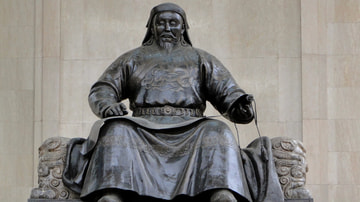
Kublai Khan
Kublai Khan (Qubilai-Qan) was the ruler of the Mongol Empire from 1260 to 1294. His accomplishments include establishing Mongol rule in China under the name of the Yuan Dynasty (1271-1368), thus becoming the first non-Chinese to rule...

Definition
Oda Nobunaga
Oda Nobunaga was the foremost military leader of Japan from 1568 to 1582. Nobunaga, along with his two immediate successors, Toyotomi Hideyoshi (1537-1598) and Tokugawa Ieyasu (1543-1616), is credited with unifying medieval Japan...
