
Search
Remove Ads
Advertisement
Search Results

Image
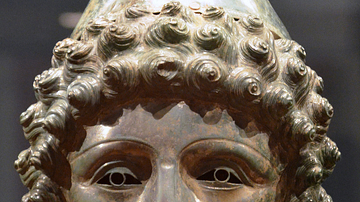
Late Roman Ridge Helmet
Roman parade helmet made of iron, silver and gold, and decorated with glass gems, Berkasovo, Serbia, 4th century CE. The photo was taken at the exhibition 'Treasures and Emperors. The Splendour of Roman Serbia' in Aquileia...
Image
Crosby Garrett Helmet
The Crosby Garrett Helmet, a copper alloy Roman cavalry helmet dating from the 1st half of 3rd century AD, found by an unnamed metal detectorist near Crosby Garrett in Cumbria in May 2010. This photo was taken on the occasion...
Image
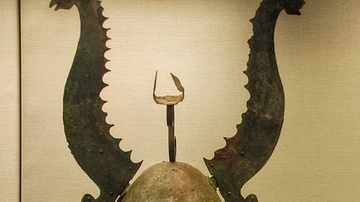
Sea-Monster Helmet
This bronze helmet has a crest with detachable horns shaped like horse-headed sea-monsters. The origin is unclear, it is perhaps a Messapian helmet from southern Italy. Circa 325-275 BCE. Castellani Collection, Bronze 2824...
Image
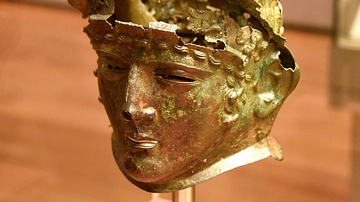
The Ribchester Helmet
A two-piece helmet of embossed bronze consisting of a head piece and a face mask. The scene on the head piece is of a skirmish between infantry and cavalry. Fittings survive on the head piece for a crest-box and a pair of...

Image
Silver-plated Helmet from Epirus
Silver-plated iron helmet found in Cist grave 1 in Prodromi, Thesprotia, Epirus, Greece. The grave is dated to between the end of the 4th century BCE and the beginning of the 3rd century BCE. (Archaeological Museum...

Image
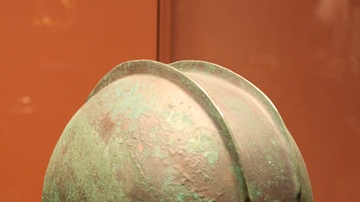
Cavalry Sports Helmet
The Nijmegen Roman cavalry helmet, an iron mask sheathed in bronze and silver discovered in 1915 CE near Nijmegen (Netherlands), second half of the first century CE. (Museum het Valkhof, Nijmegen) According to Arrian of Nicomedia...
Image
Bronze Illyrian Helmet
A bronze illyrian type helmet and gold funerary mask. Chalcidice, 530-510 BCE. (National Archaeological Museum, Athens)

Image
16th Century Morion Helmet
A typical steel morion helmet, a type worn across Europe in the 16th century and worn by conquistadors in the New World. Italian, c. 1570. (Metropolitan Museum of Art, New York)
Image
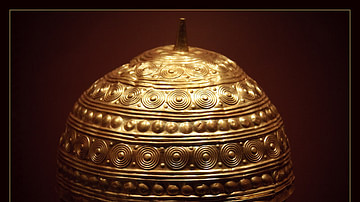
Bronze Age Helmet
Bronze Age golden helmet found in Leiro, Galicia (modern-day Spain). Museo de San Antón, A Coruña.

Image
Crested Bronze Helmet, Rutigliano
A crested bronze helmet, Rutigliano (Bari), southern Italy. 430-400 BCE. (National Archaeological Museum of Taranto, Italy)
