
Search
Did you mean: Norns?
Remove Ads
Advertisement
Search Results
Article
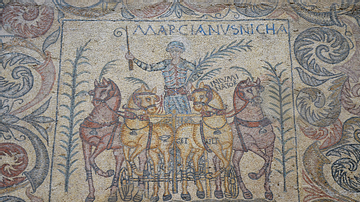
Chariot Racing in Ancient Rome
Chariot racing was very big business in ancient Rome. There was a whole industry built around the factions, the four professional stables known by their team colour – Blue, Green, Red, and White –, providing all that...

Article
Christian Antisemitism in the Middle Ages & during the Reformation
Antisemitism is a modern term that describes prejudice and hostility to Jews and Judaism. The origins of Christian antisemitism in the gospels are based on the story of a 1st-century itinerant...

Article
George W. Crooks' Account of the Dakota War of 1862 - Eye-Witness to the Minnesota Massacre
George W. Crooks' Account of the Dakota War of 1862 is an eye-witness narrative of the events leading up to the "Minnesota Massacre" known as the Dakota War of 1862 (also...

Article
Ara Pacis Augustae
The Ara Pacis Augustae or Altar of the Augustan Peace in Rome was built to celebrate the return of Augustus in 13 BCE from his campaigns in Spain and Gaul. The marble structure, which once stood on the Campus Martius, is a masterpiece...

Article
Trade in the Phoenician World
The Phoenicians, based on a narrow coastal strip of the Levant, put their excellent seafaring skills to good use and created a network of colonies and trade centres across the ancient Mediterranean. Their major trade...
Article
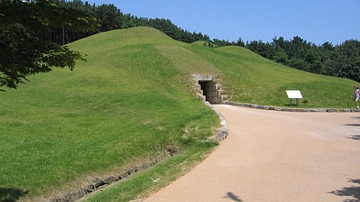
The Tomb of King Muryeong
The tomb of king Muryeong is perhaps one of the most impressive tombs from the Baekje kingdom of ancient Korea, both in its design and the treasure found inside it. Muryeong-Wang (also Munyeong or Muryong) reigned from...

Image
Kushan Coin of Kanishka II
This Kushan coin depicts a goddess of prosperity seated on a throne; this goddess was known to the Kushans as Ardochsho. Almost all late Kushan coins used the design of a seated goddess, and the Kushan Emperors produced...
Image
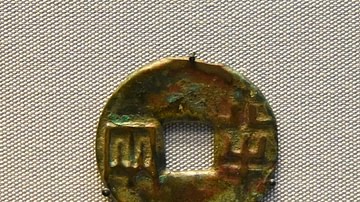
Banliang Coin
When Qin Shihuang (the First Emperor) unified the Warring States in 221 BCE, he standardized the coinage. He made the banliang (half-ounce) coin of the Qin State standard throughout the Empire, and declared all other coins obsolete...

Image
Seleucid Coin with Date
In the ancient world, some coins had dates on them. giving us precise information as to when people ruled. These coins are inscribed with dates, so they give fixed points in the chronology of ancient states, to which other...
Image
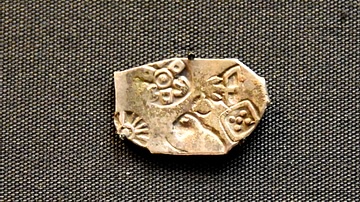
Early Indian Punch-Marked Coin
Early Indian coins were made by cutting sheets of silver into pieces and marking each piece with one or more symbols using small punches. As there are no portraits or inscriptions, the coins are now known by numbers...
