
Search
Did you mean: Norns?
Remove Ads
Advertisement
Search Results

Image
Ardashir I - Founder of the Sassanid Persian Empire
Ardashir V of Persis | Ardeshir the Unifier | Ardashir I | اردشیر یکم (l. c. 180-241 CE, r. 224-240 CE) A visual representation of Ardeshir I (the Unifier), founder of the Sasanian Empire (Larger Iran...
Image
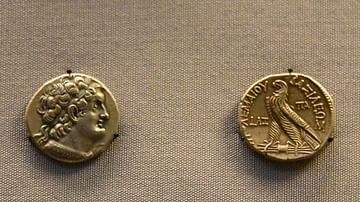
Silver Tetradrachm Coin of Ptolemy III Euergetes II
Both coins were minted in Alexandria, modern-day Egypt. The left coin was minted in 137-136 BCE while the right one in 133-132 BCE. In ancient Egypt, many transactions were made in metal, measured using...

Image
Coin from Cyrene Showing Silphium Plant
Many Greek coins showed images of local products. Cyrene was famous for the export of the now-extinct silphium plant. Silver tetradrachm coin. From Cyrene, modern-day Libya. 435-375 BCE. (The British Museum...
Image
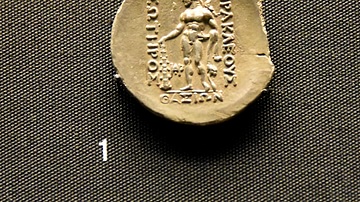
Celtic Coin Copying Greek Inscription
Early Iron Age Celtic people copied Greek coins, often faithfully reproducing their designs and inscriptions. This suggests that Thracian die-engravers were illiterate, as legible Greek letters were gradually...
Image
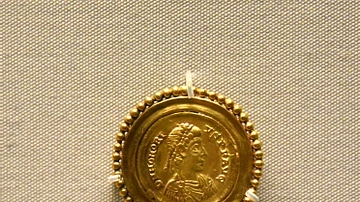
Brooch with Coin of Emperor Honorius
Roman gold coins were set into rings, to be worn. Decorative frames were added to turn others into brooches. The image of the emperor was believed to be a good luck charm, so it made sense to carry it around all...
Image
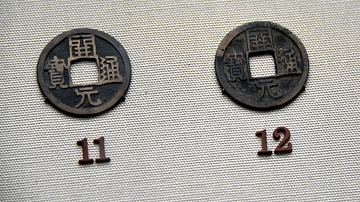
Bronze Haiyuan Tongbao Coin
Also called Kaiyuan tongbao. This was the first imperial coin to use a four-character inscription with the term tongbao , meaning "coin", (circulating money), which then became customary on Chinese coins up to the 20th...
Image
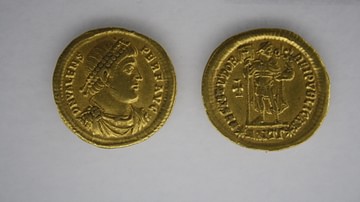
Valens Gold Solidus
Two gold solidus coins depicting Roman emperor Valens, r. 364-378 BCE. Provenance: north-west France. (Vannes Archaeological Museum, France)
Image
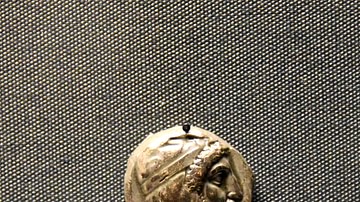
Coin of a Persian Satrap
In the Persian Empire, some regional governors (satraps) were authorized to issue coins for military purposes. They combine Persian and Greek imagery, showing a satrap's head and a local reverse image. These are some of...

Image
Celtic Coin from Thrace Copying Greek Inscription
Early Iron Age Celtic people copied Greek coins, often faithfully reproducing their designs and inscriptions. This suggests that Thracian die-engravers were illiterate, as legible Greek letters were...
Image
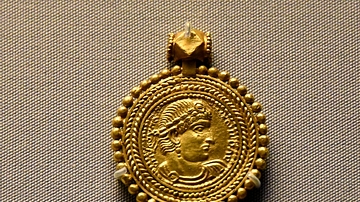
Gold Pendant from India/Pakistan
One side (reverse) of this elaborate gold pendant has designs based on coins of the Kushan rulers Kanishka I (100-126 CE) or Huvishka (126-163 CE); it shows an image of the goddess of wealth. On the other side (obverse...
