
Search
Remove Ads
Advertisement
Search Results
Image
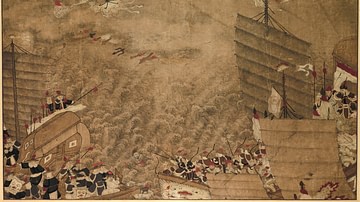
Wako & Chinese Naval Battle
An 18th century CE illustration showing a naval battle between Japanese pirates (wako) and Chinese naval ships. (Rijksmuseum, Amsterdam)

Image
Chinese Shoe for a Bound Foot
A Chinese silk shoe designed to be worn by a woman with bound-feet. 18th century CE. (Musées du château des Rohan, Musée Louise Weiss, Saverne, France)

Image
12 Animals of the Chinese Zodiac
Jade figurines representing the 12 animals of the Chinese zodiac. 18th century CE, Qing Dynasty. Height: c. 5.7 cm. (Metropolitan Museum of Art, New York)

Image
Chinese Jade Cormorant
A Chinese jade plaque of a cormorant and fish. 1100-900 BCE. Height: 4 cm. (British Museum, London)
Image
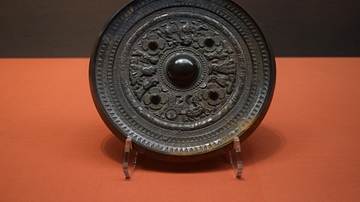
Chinese Bronze Mirror
Engraved Chinese bronze mirror with a deity and horse carriage design. From the 4th-5th century CE Samitatakarazuka Tumulus, Japan. From 2nd-3rd century CE China. Important Cultural Property. (Tokyo National Museum)

Video
The Lives of Women in Ancient China
In Ancient China, it was widely known that it was better to be born a male than a female. To be born a female meant being subordinate to one’s father, then to one’s husband and if a wife became a widow, then she...

Definition
Yayoi Period
The Yayoi Period is one of the oldest historical periods of Japan spanning from c. 300 BCE to c. 250 CE, preceded by the Jomon Period and followed by the Kofun Period. The name Yayoi comes from the district in Tokyo where the first...

Definition
Nihon Shoki
The Nihon Shoki ('Chronicle of Japan' and also known as the Nihongi) is an official history of Japan which was written by a committee of court scholars in 720 CE. It is a compilation of myths and legends concerning the Shinto gods...

Definition
Pushyabhuti Dynasty
The Pushyabhuti Dynasty (c. 500 CE - 647 CE) rose after the downfall of the Gupta Empire (3rd century CE - 6th century CE) in the 6th century CE in northern India. Also known as the Vardhana or Pushpabhuti Dynasty, the core...

Definition
Chagatai Khanate
The Chagatai Khanate (also Chaghatai, Jagatai, Chaghatay or Ca'adai, c. 1227-1363 CE) was that part of the Mongol Empire (1206-1368 CE) which covered what is today mostly Uzbekistan, southern Kazakhstan, and western Tajikistan...
