
Search
Remove Ads
Advertisement
Search Results

Video
Japanese Religion: Shinto
Shinto is the indigenous religion of Japan, a life-affirming animism calling upon the blessings of the numinous forces of nature and of specific spirit deities. Shinto is largely associated with growth and prosperity...

Article
Ghosts in Ancient China
Ghost stories were the earliest form of literature in ancient China. They were almost certainly part of a very old oral tradition before writing developed during the Shang Dynasty (1600-1046 BCE) and they continue to be...

Definition
Portuguese Malacca
The Portuguese colonised Malacca (modern Melaka) on the southwest coast of the Malay peninsula from 1511 and kept it until 1641 when the Dutch took over. The port controlled the Malay Straits which lead from the Indian Ocean...

Definition
Script - The Written Record of Humanity
Script is the written expression of a language. Cuneiform, the first script, was invented in Sumer, Mesopotamia, circa 3600/3500 BCE; hieroglyphics sometime prior to the Early Dynastic Period in Egypt (circa...

Definition
The Secret History of the Mongols
The Secret History of the Mongols is a chronicle written in the 13th century CE (with some later additions) and is the most important and oldest medieval Mongolian text. The book covers the origins of the Mongol...
Definition
Ennin
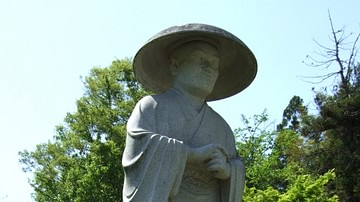
Ennin (c. 793-864 CE, posthumous title: Jikaku Daishi) was a Japanese Buddhist monk of the Tendai sect who studied Buddhism at length in China and brought back knowledge of esoteric rituals, sutras, and relics. On his return, he published...

Definition
Sejong the Great
King Sejong the Great (15 May 1397 to 8 April 1450 CE) ruled Korea from 1418 to 1450 CE as the fourth king of the Joseon Dynasty (also spelled Choson). One of only two Korean kings called 'the Great' today, Sejong had a major...

Definition
Louis I de Bourbon, Prince of Condé
Louis I de Bourbon (l. 1530-1569) was a descendant of Louis IX of France (r. 1226-1270) and founder of the House of Condé. The Prince of Condé proved his valor as a Huguenot military leader during the first three...

Definition
Mesopotamia - The Beginning of Beginnings
Mesopotamia (from the Greek, meaning "between two rivers") was an ancient region located in the Near East (Middle East) bounded in the northeast by the Zagros Mountains and in the southeast by the Arabian Plateau...

Article
Ten Ancient Rome Facts You Need to Know
Ancient Roman culture affected vast numbers of people across the known world of its time, beginning with the rise of the Roman Republic (509-27 BCE) and throughout the duration of the Roman Empire (27 BCE -...
