
Search
Remove Ads
Advertisement
Search Results

Definition
Fenrir
Fenrir is the great wolf in Norse Mythology who breaks free from his chains at Ragnarök, the twilight of the gods, kills Odin, and is then killed by Odin’s son Vidarr. Fenrir is the son of the trickster god Loki and brother of the World...

Definition
Ceres
Ceres is the goddess of agriculture and the harvest in Roman mythology. Her favor would bring humankind plentiful harvests and fruitful crops, but her wrath brought blight, drought, and famine. Usually depicted as a matron, her symbols...

Definition
Freyr
Freyr (Old Norse for 'Lord', sometimes anglicised as Frey) is the main fertility god in Norse mythology, his connection with harvests, sun and rain, virility, weddings, and his rule over wealth securing him an important position within...

Definition
Centaur
A centaur was a creature from Greek mythology which was half-man and half-horse. The head, arms and torso of a centaur were human and joined at the waist to the body and legs of a horse. Centaurs represented barbarism and unbridled chaos...

Definition
Jörmungandr
Jörmungandr is the Midgard Serpent (also World Serpent) in Norse mythology who encircles the realm of Midgard. He is the son of the god Loki and the giantess Angrboða and brother of the great wolf Fenrir and Hel, Queen of the Dead...

Definition
Saturn
Saturn (Saturnus) was a Roman god with a similar history to Cronus from Greek mythology. Often depicted in art wielding a scythe he was considered an agricultural god, especially associated with seed-corn. The Saturnalia festival, named...
Definition
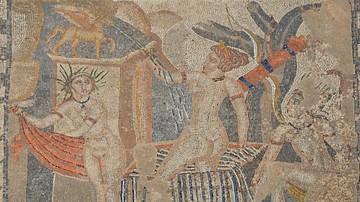
Diana
Diana was the goddess of childbirth, the fertility goddess, the goddess of the moon as well as the patron goddess of wild beasts in Roman mythology. However, she is best known as the goddess of the hunt, with her sacred animal being the...

Definition
Ragnarök - The Cataclysmic Battle of Norse Mythology
Ragnarök is the cataclysmic battle between the forces of chaos and those of order in Norse mythology, ending the world and killing most of the gods and their adversaries, leading to the birth of a new...

Definition
Writing - The Preservation of Human Thought and Action
Writing is the physical manifestation of a spoken language. It is thought that human beings developed language circa 35,000 BCE as evidenced by cave paintings from the period of the Cro-Magnon Man...

Video
The Nine Realms of Norse Cosmology
The Norse people in their mythology divided their universe into nine realms with the world tree, Yggdrasil, in the centre. From Yggdrasil the nine realms of their cosmology either spread out from it or they stretched...
