
Search
Remove Ads
Advertisement
Search Results

Image
1804 Chinese Junk
An 1804 print of a Chinese junk ship. The junk was capable of operating in shallow waters or on ocean voyages and was a mainstay of merchant and pirate shipping in Asia for centuries.
Image
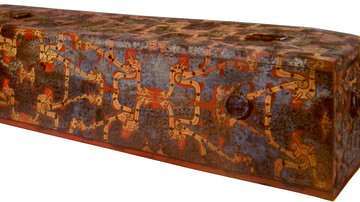
Chinese Lacquered Coffin
A Chinese lacquered coffin with dragon and bird decoration from the Chu state. 4th century BCE. (Hubei Provincial Museum, Wuhan, China)

Image
Chinese Warrior
A detail of a Chinese warrior from the Terracotta Army buried near the tomb of Qin emperor Shi Huangdi, c. 210 CE. Shaanxi Province, China.
Image
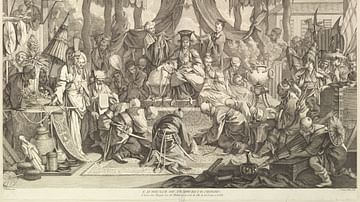
An Audience with a Chinese Emperor
An 18th century CE engraving by Jacques Gabriel Huquier illustrating an audience with a Chinese emperor. (The Metropolitan Museum of Art, New York)

Image
Chinese Eunuchs
A mural depicting a group of eunuchs, the slaves and influential advisors of many Chinese emperors. Mural from the tomb of the prince Zhanghuai, 706 CE, Qianling, Shaanxi, China.

Video
7 Greatest Philosophers in Chinese History
Meet the greatest philosophers in Chinese history.

Image
Chinese Army on the March
Artist's impression of the Chinese army marching into battle.

Video
The Concept and Symbol of Yin and Yang Explained
The principle of Yin and Yang dates from the third century BCE and perhaps even later than that, and is the foundational principle of Chinese philosophy and Chinese medicine. Yin and Yang is a symbol...

Definition
Samhain
Samhain (pronounced “SOW-in” or “SAH-win”), was a festival celebrated by the ancient Celts halfway between the autumn equinox and the winter solstice. It began at dusk around October 31st and likely lasted three days. Samhain marked...

Video
Ragnarok: The Final Battle of the Norse Gods (Part 3/3) - Norse Mythology Stories - See U in History
Ragnarök: The Final Battle of the Norse Gods - Norse Mythology Stories
