
Search
Remove Ads
Advertisement
Search Results
Article
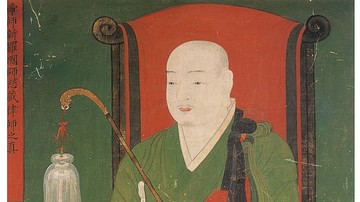
Famous Buddhist Monks of Ancient Korea
Throughout ancient Korea's history Buddhist monks were a particularly important element of state and religious affairs. From the 4th century CE onwards, in the Three Kingdoms period, they were members of a select...

Definition
Chariot
The chariot was a light vehicle, usually on two wheels, drawn by one or more horses, often carrying two standing persons, a driver and a fighter using bow-and-arrow or javelins. The chariot was the supreme military weapon in Eurasia...

Article
Ten North American Native Facts You Need To Know
The history and culture of the Native Peoples of North America are often overlooked as they have been largely eclipsed by the history of the European settlers who colonized the region beginning in the...

Definition
Emperor of Japan
The emperor of Japan is a position as the head of state which traditionally dates back to the 7th century BCE and the legendary figure of Emperor Jimmu (r. 660-585 BCE). Emperors came to be known as the Tenno or 'heavenly sovereign'...

Definition
Lumbini
Lumbini is a village, archaeological site, and place of pilgrimage honored as the birthplace of Siddhartha Gautama (the Buddha, l. c. 563-483 BCE) located in modern-day Rupandehi District of Nepal, Province 5, near the Indian border...

Definition
Periplus of the Erythraean Sea
The Periplus of the Erythraean Sea is an eyewitness account of ancient travel to Africa and India via the Red Sea written by an unknown Greek-speaking Egyptian author in the 1st century CE. In this detailed account...

Definition
Kapilavastu
Kapilavastu (“Place of Kapila”) is the name of the city where Siddhartha Gautama (the Buddha, l. c. 563-483 BCE) grew up and lived for the first 29 years of his life before leaving to pursue the spiritual path which led to his enlightenment...

Definition
Harsha
Emperor Harshavardhana, better known as Harsha, lived from 590 to 647 CE and was the last ruler of the Vardhana Empire, the last great empire in ancient India before the Islamic Invasion. He ruled from 606 CE to 647 CE. After Harshavardhana's...

Definition
Nara Period
The Nara Period (Nara Jidai) of ancient Japan (710-794 CE), so called because for most of that time the capital was located at Nara, then known as Heijokyo, was a short period of transition prior to the significant Heian Period. Despite...

Definition
Gwanggaeto the Great
Gwanggaeto (Kwanggaeto), often referred to as Gwanggaeto the Great, was king of the Goguryeo (Koguryo) kingdom which ruled northern Korea during the Three Kingdoms period. Gwanggaeto reigned between 391 and 413 CE, and living...
