
Search
Remove Ads
Advertisement
Search Results

Definition
Kapilavastu
Kapilavastu (“Place of Kapila”) is the name of the city where Siddhartha Gautama (the Buddha, l. c. 563-483 BCE) grew up and lived for the first 29 years of his life before leaving to pursue the spiritual path which led to his enlightenment...

Definition
Gwanggaeto the Great
Gwanggaeto (Kwanggaeto), often referred to as Gwanggaeto the Great, was king of the Goguryeo (Koguryo) kingdom which ruled northern Korea during the Three Kingdoms period. Gwanggaeto reigned between 391 and 413 CE, and living...

Definition
Mongol Warfare
The Mongols conquered vast swathes of Asia in the 13th and 14th century CE thanks to their fast light cavalry and excellent bowmen, but another significant contribution to their success was the adoption of their enemies' tactics...

Definition
Samguk Yusa
The Samguk yusa ('Memorabilia of the Three Kingdoms') is a 13th-century CE text which covers the history and legends of Korea's founding right up to the 10th century CE. It is a sequel of sorts to the earlier Samguk sagi ('Records...

Definition
Portuguese Nagasaki
Nagasaki, on the northwest coast of Japan’s Kyushu Island, was an important Portuguese trading base from c. 1571 to 1639, and the most eastern outpost of the Portuguese empire. The Portuguese presence transformed Nagasaki from...

Definition
Meiji Restoration
The Meiji Restoration was a political event that took place in Japan in 1868. In it, the Tokugawa family, a warrior clan that had ruled Japan for more than 260 years, was overthrown by a group of political activists who proclaimed...

Definition
Japanese Tea Ceremony
The Japanese Tea Ceremony (chanoyu or chado) is a cultural tradition involving very particular places, procedures, and equipment for drinking green tea. Originating as a habit of Chinese Buddhist monks to aid their meditation...

Definition
Mongol Empire
The Mongol Empire (1206-1368) was founded by Genghis Khan (r. 1206-1227), first Great Khan or 'universal ruler' of the Mongol peoples. Genghis forged the empire by uniting nomadic tribes of the Asian steppe and creating a devastatingly...

Definition
Knossos
Knossos (pronounced Kuh-nuh-SOS) is the ancient Minoan palace and surrounding city on the island of Crete, sung of by Homer in his Odyssey: “Among their cities is the great city of Cnosus, where Minos reigned when nine years old, he...
Definition
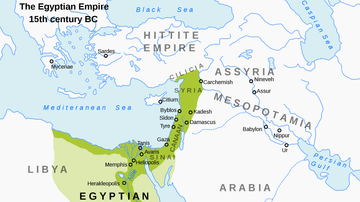
Egyptian Empire
The Egyptian Empire rose during the period of the New Kingdom (c. 1570- c. 1069 BCE), when the country reached its height of wealth, international prestige, and military might. The empire stretched from modern-day Syria in the...
