
Search
Search Results

Definition
Carolingian Dynasty
The Carolingian Dynasty (751-887) was a family of Frankish nobles who ruled Francia and its successor kingdoms in Western and Central Europe during the Early Middle Ages. The dynasty expanded from Francia as far as modern Italy, Spain, and...

Article
Causes of the English Civil Wars
The English Civil Wars (1642-1651) were caused by a monumental clash of ideas between King Charles I of England (r. 1625-1649) and his parliament. Arguments over the powers of the monarchy, finances, questions of religious practices and toleration...
Definition
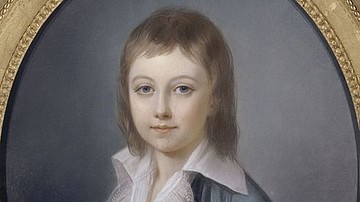
Louis XVII of France
Louis XVII of France was the regnal name of Louis-Charles de France (l. 1785-1795), the younger son of King Louis XVI of France (r. 1774-1792) and Queen Marie Antoinette (l. 1755-1793). Although Louis-Charles never actually reigned as king...

Definition
Charles Vane
Captain Charles Vane was an English pirate active in the Caribbean and off the east coast of North America between 1716 and 1720. The pirate, who infamously refused a pardon and instead fired his cannons at the ship of Governor Woodes Rogers...

Definition
Kingdom of West Francia
The Kingdom of West Francia (843-987 CE, also known as The Kingdom of the West Franks) was the region of Western Europe that formed the western part of the Carolingian Empire of Charlemagne (Holy Roman Emperor 800-814 CE) known as Francia...

Article
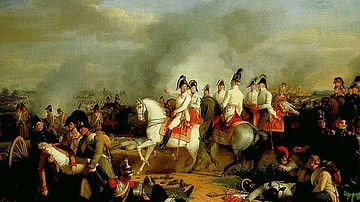
Battle of Wagram
The Battle of Wagram (5-6 July 1809) was one of the largest and bloodiest battles of the Napoleonic Wars (1803-1815). It resulted in a pyrrhic victory for French Emperor Napoleon I (r. 1804-1814; 1815) whose army crossed the Danube River...
Article
Battle of Aspern-Essling
The Battle of Aspern-Essling (21-22 May 1809) was a major battle of the Napoleonic Wars (1803-1815). It saw an Austrian army under Archduke Charles defeat a French army led by Emperor Napoleon I (r. 1804-1814; 1815) as it attempted to cross...

Definition
English Civil Wars
The English Civil Wars (1642-1651) witnessed a bitter conflict between Royalists ('Cavaliers') and Parliamentarians ('Roundheads'). The Royalists supported first King Charles I of England (r. 1625-1649) and then his son Charles II, while...

Definition
Hundred Years' War
The Hundred Years' War (1337-1453) was an intermittent conflict between England and France lasting 116 years. It began principally because King Edward III (r. 1327-1377) and Philip VI (r. 1328-1350) escalated a dispute over feudal rights...

Definition
War of the Fifth Coalition
The War of the Fifth Coalition (1809) was a major conflict of the Napoleonic Wars (1803-1815) that was fought primarily in Central Europe between the First French Empire and its client states against the Austrian Empire, supported by the...
