
Search
Did you mean: Kassite?
Remove Ads
Advertisement
Search Results

Definition
Amphora
An amphora (Greek: amphoreus) is a jar with two vertical handles used in antiquity for the storage and transportation of foodstuffs such as wine and olive oil. The name derives from the Greek amphi-phoreus meaning 'carried on both sides'...

Definition
Ptolemy II Philadelphus
Ptolemy II Philadelphus ("The Sibling Loving", r. 282-246 BCE) was the second ruler of the Ptolemaic Dynasty. He consolidated the kingdom conquered by his father Ptolemy I and presided over its golden age. Ptolemy II invested...

Definition
Malia
Located near a fertile plain in northern Crete and with its own harbour, Malia was one of the major settlements and palaces of the Minoan civilization. Inhabited since Neolithic times (6000 BCE) and with the first evidence of monumental...

Definition
Johann Strauss II
Johann Strauss II (1825-1899), aka Strauss the Younger, was an Austrian composer best known for his waltzes such as The Blue Danube. Famed throughout Europe and the United States in his own lifetime, Strauss was known as the...

Definition
Utica
Utica (also Utique), 33km north of Tunis, was the first Phoenician colony on the North African coast. The strategically important port was an ally to Carthage in the First Punic War, but the city switched sides in the Second and Third...
Definition
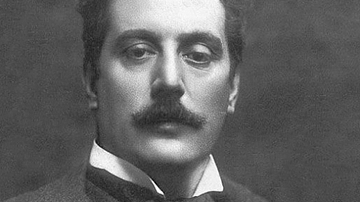
Giacomo Puccini
Giacomo Puccini (1858-1924) was an Italian composer best known for his operas La Bohème, Tosca, Madama Butterfly, and Turandot. Puccini drew inspiration from a wide range of literary sources, and his late Romantic music with its...

Definition
Paros
Paros is an island in the Cyclades group in the central Aegean. It is the third largest island of the Cyclades and its position on important sea routes between mainland Greece and the coast of Asia Minor made it an important centre from...
Definition
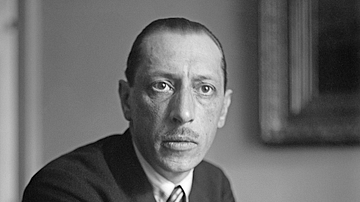
Igor Stravinsky
Igor Stravinsky (1882-1971) was a Russian composer best known for his works for the stage, such as the ballets The Firebird, Petrushka, and the groundbreaking The Rite of Spring. The modernist composer lived in Switzerland, France...

Definition
Vulcan
Vulcan or Volcanus was the Roman god of fire and forge, the equivalent of Hephaestus from Greek mythology. The son of Jupiter and Juno, he was the special patron of blacksmiths and artisans. As the god of the forge and the devastating...

Definition
Cyrenaics
The Cyrenaics were a philosophical school of thought founded c. 4th century BCE by Aristippus of Cyrene (l. c. 435-356 BCE) who taught that sensual pleasure was the highest good and only worthwhile pursuit in life. Known as the first...
